
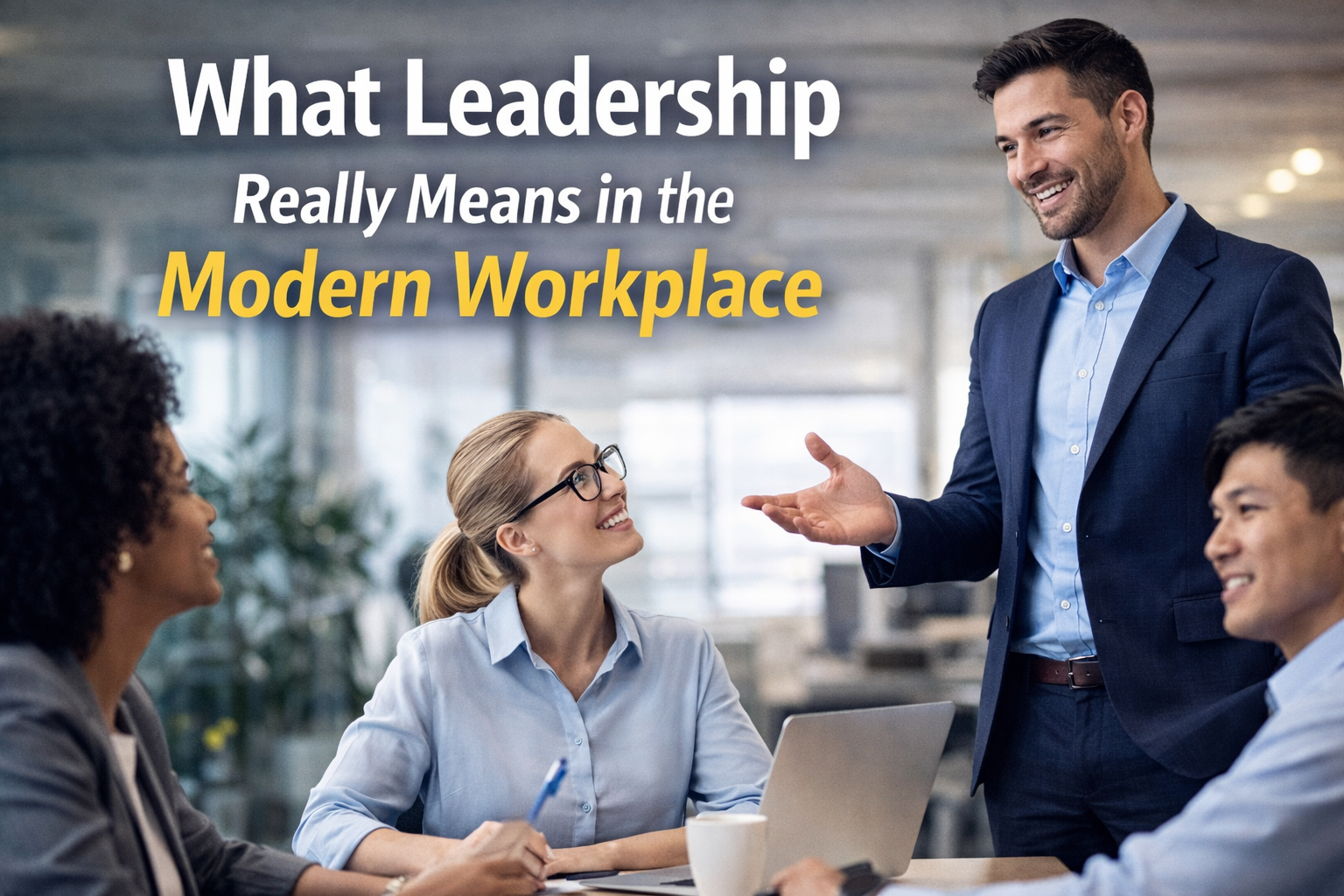
Leadership in the modern workplace goes far beyond holding a title or supervising tasks. Over the past two decades, research in organizational psychology, management science, and workforce analytics has shown that leadership is increasingly defined by influence, adaptability, and the ability to develop others rather than authority alone. As work environments evolve due to technology, globalization, and changing employee expectations, so does the meaning of effective leadership.
Understanding what leadership truly represents today is essential for professionals at every level. Leadership is no longer restricted to executives. It is a set of skills and behaviors that can be developed, measured, and improved over time.
The Evolution of Leadership Models
Traditional leadership theories emphasized hierarchy, command structures, and centralized decision-making. Early 20th-century models often focused on traits and authority. However, contemporary research has shifted toward relational and behavioral frameworks.
According to research published in The Leadership Quarterly, leadership effectiveness is strongly associated with behaviors that promote trust, empowerment, and collaboration rather than rigid control (Dinh et al., 2014). This shift reflects the complexity of modern organizations, where innovation and adaptability are critical.
The World Economic Forum has also emphasized that leadership in the Fourth Industrial Revolution requires skills such as emotional intelligence, complex problem-solving, and people management (World Economic Forum, Future of Jobs Report, 2023). These findings highlight how leadership expectations have expanded beyond traditional management functions.
Leadership as Influence Rather Than Authority
Modern leadership is best understood as influence. Research by Gallup shows that managers account for at least 70% of the variance in employee engagement scores (Gallup, State of the American Manager). Engagement is not driven by positional power, but by how leaders communicate, support, and inspire their teams.
Influence-based leadership encourages voluntary commitment rather than compliance. Studies in organizational psychology demonstrate that employees are more motivated when they feel respected and involved in decision-making processes (Deci & Ryan, Self-Determination Theory).
In practical terms, this means leadership effectiveness depends less on issuing directives and more on building alignment and shared purpose.
Communication as a Core Leadership Competency
Clear and transparent communication is consistently ranked as one of the most critical leadership skills. A report from McKinsey & Company found that organizations with strong communication practices are significantly more likely to outperform their peers during periods of change (McKinsey, 2020).
Effective leaders communicate expectations clearly, provide constructive feedback, and actively listen. Research published in the Harvard Business Review indicates that leaders who foster open communication increase trust and psychological safety within teams (Edmondson, 2018).
In remote and hybrid environments, communication becomes even more essential. Clarity reduces uncertainty, aligns goals, and strengthens collaboration across distributed teams.
Emotional Intelligence and Leadership Effectiveness
Emotional intelligence (EI) has become central in leadership research. According to a study published in the Journal of Organizational Behavior, leaders with higher emotional intelligence demonstrate stronger team performance and better conflict resolution outcomes (Miao, Humphrey & Qian, 2018).
Psychologist Daniel Goleman popularized the concept of emotional intelligence in leadership, arguing that self-awareness, empathy, and emotional regulation are key differentiators between average and exceptional leaders.
Data from TalentSmart, which analyzed emotional intelligence alongside workplace performance, suggests that EI accounts for a substantial portion of job performance across industries. While technical expertise matters, the ability to manage emotions and relationships significantly influences leadership success.
Adaptability in a Rapidly Changing Work Environment
The pace of workplace transformation has accelerated due to automation, artificial intelligence, and shifting economic conditions. The World Economic Forum estimates that nearly half of all employees will require reskilling or upskilling in the coming years due to technological change (World Economic Forum, 2023).
Leadership in this environment requires adaptability. Research from Deloitte highlights that organizations with adaptable leaders are better positioned to respond to disruption and maintain performance during uncertainty (Deloitte Human Capital Trends).
Adaptable leaders model flexibility, encourage learning, and remain open to new ideas. This approach reduces resistance to change and fosters resilience within teams.
Trust as the Foundation of Modern Leadership
Trust is one of the strongest predictors of leadership effectiveness. The Edelman Trust Barometer consistently finds that employees expect transparency, ethical behavior, and accountability from organizational leaders (Edelman, 2023).
Workplace studies show that high-trust environments correlate with greater employee engagement, lower turnover, and improved productivity. When leaders consistently follow through on commitments and communicate honestly, they create psychological safety a condition that research by Amy Edmondson at Harvard identifies as critical for team learning and innovation.
Without trust, even technically skilled leaders struggle to maintain long-term influence.
Leadership Beyond Formal Titles
Modern organizations increasingly recognize that leadership behaviors are not limited to those in management positions. Research in shared leadership models indicates that teams perform better when leadership responsibilities are distributed rather than centralized.
A meta-analysis published in the Journal of Applied Psychology found that shared leadership positively predicts team effectiveness, particularly in knowledge-based work environments (Wang, Waldman & Zhang, 2014).
This means employees who demonstrate initiative, accountability, and collaboration contribute meaningfully to leadership processes, regardless of their title.
Ethical Leadership and Organizational Performance
Ethical leadership has gained prominence due to growing expectations for corporate responsibility. Research published in the Academy of Management Journal links ethical leadership with increased employee satisfaction and reduced misconduct.
Integrity, fairness, and transparency are no longer optional leadership traits. They directly impact organizational reputation and long-term performance.
In modern workplaces, ethical leadership also supports diversity, equity, and inclusion initiatives. Leaders who prioritize fairness foster stronger cultures and more sustainable success.
Leadership Development as a Learnable Skill
One of the most important conclusions from contemporary research is that leadership is not solely innate. It can be developed through structured learning, feedback, and experience.
According to the Center for Creative Leadership, leadership development programs improve both individual performance and organizational outcomes. Longitudinal studies show measurable growth in communication, decision-making, and interpersonal effectiveness after targeted leadership training.
Neuroscience research further supports this idea. Studies on neuroplasticity demonstrate that behavioral patterns and interpersonal skills can strengthen with deliberate practice over time.
This evidence reinforces a critical point: leadership is a skill set that evolves through continuous learning and self-awareness.
Leadership in Remote and Hybrid Work Models
The rise of hybrid and remote work has reshaped leadership expectations. A report from Microsoft in its Work Trend Index highlights that employees value autonomy and flexibility but require clarity and consistent communication from leaders.
Remote leadership depends on outcomes rather than physical presence. Leaders must build trust without constant supervision, encourage accountability, and maintain engagement across digital platforms.
These changes further demonstrate that leadership today centers on communication, adaptability, and emotional intelligence rather than traditional oversight.
Redefining Leadership for Today’s Workplace
Leadership in the modern workplace is defined by influence, trust, adaptability, and ethical responsibility. It is grounded in research across psychology, management science, and workforce analytics.
Data from Gallup, the World Economic Forum, Deloitte, and academic journals consistently show that effective leadership improves engagement, innovation, resilience, and long-term performance.
Most importantly, leadership is not restricted to a specific personality type or job title. It is a collection of skills that can be developed with intention and practice. By focusing on communication, emotional intelligence, adaptability, and integrity, professionals at every level can contribute to stronger teams and healthier organizations.
In today’s evolving professional landscape, leadership is not about control. It is about guiding people through change, building trust, and creating environments where individuals and organizations can grow sustainably.
References
Dinh, J. E., et al. (2014). Leadership theory and research in the new millennium. The Leadership Quarterly.
Edelman (2023). Edelman Trust Barometer.
Gallup (2015–2023). State of the American Manager; State of the Global Workplace.
Miao, C., Humphrey, R., & Qian, S. (2018). Emotional intelligence and job performance. Journal of Organizational Behavior.
Wang, D., Waldman, D., & Zhang, Z. (2014). Shared leadership and team effectiveness. Journal of Applied Psychology.
World Economic Forum (2023). Future of Jobs Report.
Deloitte (2023). Global Human Capital Trends.
Microsoft (2023). Work Trend Index.