
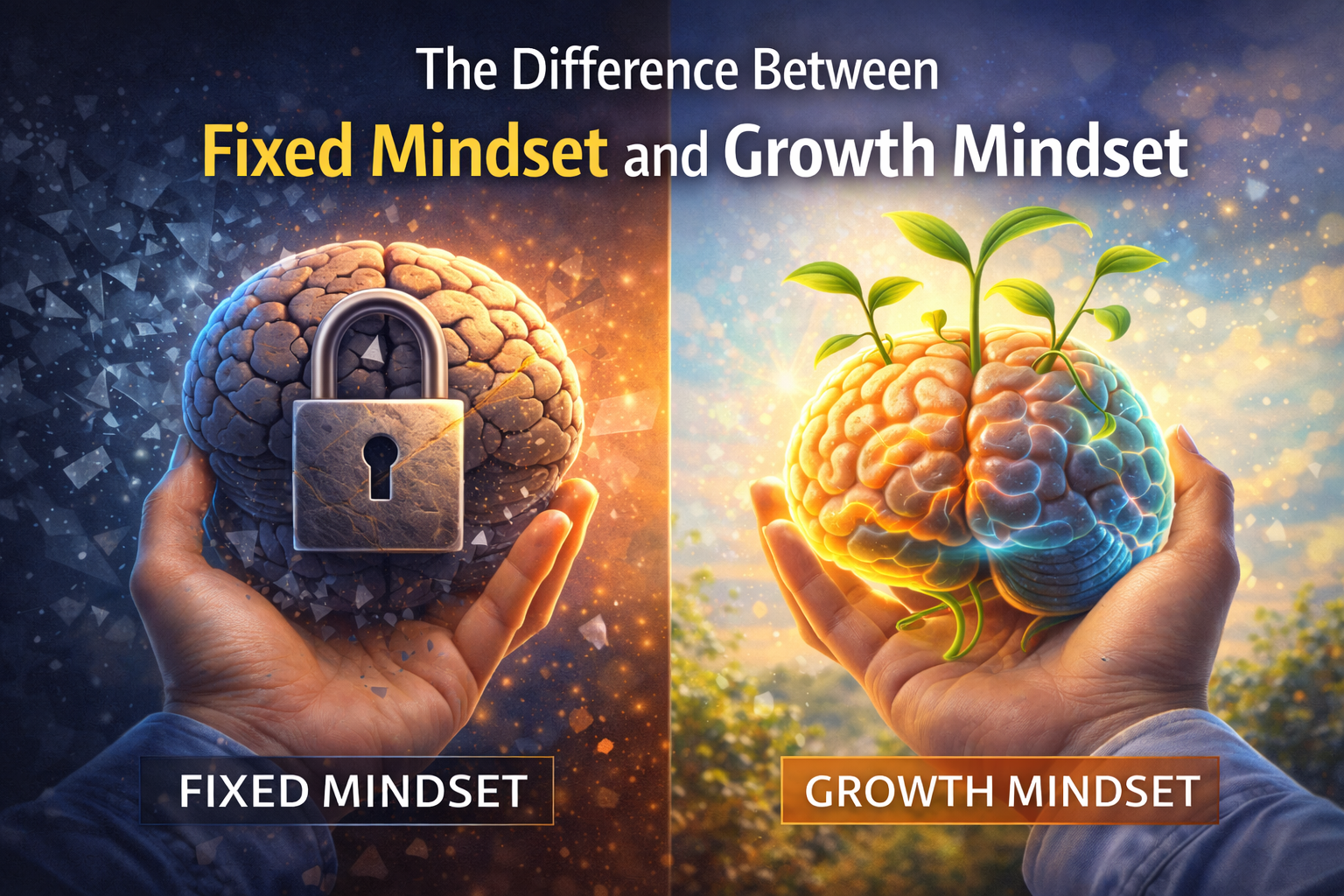
The way people perceive their intelligence, abilities, and potential significantly influences how they learn, perform, and respond to challenges. In psychology, these beliefs are described as mindsets. Over the past two decades, research in educational, cognitive, and organizational psychology has examined how mindset shapes motivation, resilience, academic achievement, and professional growth.
The distinction between a fixed mindset and a growth mindset was introduced and popularized by psychologist Carol S. Dweck of Stanford University. Since then, numerous empirical studies have explored how these belief systems affect real-world outcomes.
This article presents research-based evidence, data from peer-reviewed studies, and credible sources to clarify what mindset is and what it is not.
Understanding Mindset in Psychology
In psychological research, mindset refers to implicit beliefs about whether personal qualities especially intelligence are fixed traits or malleable attributes that can develop through effort and learning.
According to Dweck (2006), individuals tend to adopt one of two dominant belief systems:
- Entity theory (Fixed mindset): Intelligence is static.
- Incremental theory (Growth mindset): Intelligence can be developed.
These beliefs influence how individuals interpret challenges, effort, and failure.
Importantly, mindset is not a personality trait. Studies show it is shaped by experiences, feedback, culture, and environment meaning it can change over time (Dweck & Leggett, 1988).
What Is a Fixed Mindset? (Entity Theory of Intelligence)
A fixed mindset reflects the belief that intelligence and talent are innate and largely unchangeable.
Research Findings
In early experimental studies, Dweck and colleagues found that students who endorsed a fixed view of intelligence were more likely to:
- Avoid challenging tasks
- Give up more quickly after setbacks
- Show decreased performance after failure
- Experience greater helpless responses
In a foundational study (Dweck & Leggett, 1988), children who believed intelligence was fixed displayed “helpless behavior” after encountering difficulty, while those who believed it was malleable persisted longer.
Further research by Mueller & Dweck (1998) demonstrated that praising intelligence (“You’re so smart”) led children to adopt more fixed-mindset behaviors, including task avoidance and performance decline after failure.
What Is a Growth Mindset? (Incremental Theory of Intelligence)
A growth mindset is the belief that abilities can be developed through effort, strategy, and feedback.
Evidence from Academic Research
A longitudinal study by Blackwell, Trzesniewski, and Dweck (2007) followed 373 students during the transition to junior high school. Key findings:
- Students who believed intelligence could grow showed increasing math grades over time.
- Students with fixed beliefs showed declining academic trajectories.
- A short intervention teaching growth mindset principles significantly improved academic performance.
These findings suggested that belief systems can predict academic progress and that targeted interventions can influence outcomes.
Large-Scale Evidence: What Do Meta-Analyses Say?
While early research showed promising results, later large-scale reviews have provided a more nuanced understanding.
A 2018 meta-analysis by Sisk et al., reviewing 273 studies involving over 365,000 participants, found:
- The overall effect size of growth mindset interventions on academic achievement was small (average effect size ≈ 0.08).
- Stronger effects were observed among:
- Economically disadvantaged students
- Students facing academic risk
This indicates that growth mindset interventions are not a universal solution but may be particularly beneficial for vulnerable populations.
Mindset and Response to Challenges
Experimental studies consistently show that mindset affects how individuals respond to setbacks.
In laboratory tasks involving unsolvable puzzles, individuals endorsing fixed beliefs were more likely to:
- Show decreased persistence
- Report lower enjoyment
- Attribute failure to lack of ability
In contrast, those with incremental beliefs were more likely to:
- Attribute failure to strategy or effort
- Try alternative approaches
- Maintain motivation
Neuroscientific research by Moser et al. (2011) found that individuals with growth-oriented beliefs showed stronger brain activity related to error correction, suggesting greater engagement in learning from mistakes.
The Role of Effort: Perception Differences
Effort plays a central psychological role in distinguishing the two mindsets.
Research shows:
- Fixed mindset: Effort may signal low ability (“If I were smart, this would be easy”).
- Growth mindset: Effort is viewed as necessary for mastery.
In educational settings, students who associate effort with improvement demonstrate higher persistence in complex tasks (Blackwell et al., 2007).
Feedback and Its Psychological Impact
Feedback influences mindset development.
Mueller & Dweck (1998) demonstrated that:
- Children praised for intelligence were more likely to choose easier tasks later.
- Children praised for effort were more likely to seek challenging tasks.
The way feedback is framed can shape whether individuals adopt performance goals (proving ability) or learning goals (improving ability).
Mindset in the Workplace
Research in organizational psychology suggests that mindset affects adaptability and learning in professional environments.
A study by Heslin & VandeWalle (2008) found that managers who believed abilities could develop were:
- More open to employee development
- More likely to coach rather than judge performance
Additionally, companies that emphasize learning and improvement cultures tend to foster psychological safety a concept extensively studied by Amy Edmondson at Harvard University.
Psychological safety has been associated with:
- Increased innovation
- Greater team learning
- Improved performance outcomes
Mindset and Emotional Resilience
Emotional resilience refers to the capacity to recover from stress or failure.
Research suggests that individuals with growth-oriented beliefs are more likely to:
- View failure as temporary
- Engage in adaptive coping strategies
- Maintain long-term motivation
However, experts caution against oversimplifying this relationship. Resilience is influenced by multiple factors, including social support, personality traits, and environment.
Criticism and Scientific Debate
While mindset theory is widely discussed, it is not without criticism.
Some researchers argue:
- Effects are modest rather than transformative.
- Replication results vary.
- Context plays a critical role.
For example, large-scale replications show that mindset interventions are most effective when combined with supportive environments and high-quality instruction.
Dweck herself has emphasized that growth mindset is not about “just trying harder,” but about:
- Using effective strategies
- Seeking help
- Persisting intelligently
Can Mindset Change Over Time?
Evidence indicates that mindset beliefs are malleable.
Short educational interventions sometimes lasting less than an hour have shown measurable changes in students’ beliefs and, in some contexts, academic outcomes (Yeager et al., 2019).
A national U.S. study involving over 12,000 ninth-grade students found that a brief online growth mindset intervention:
- Improved grades among lower-achieving students
- Increased enrollment in advanced math courses
However, effects were strongest in schools that supported challenge-seeking norms.
Common Misunderstandings About Growth Mindset
Growth mindset does not mean:
- Ignoring structural barriers
- Believing anyone can achieve anything instantly
- Replacing strategy with blind persistence
Scientific evidence shows that:
- Effort must be paired with effective strategies.
- Environment significantly influences outcomes.
- Systemic factors matter alongside personal beliefs.
Practical Comparison: Fixed vs. Growth Mindset
| Dimension | Fixed Mindset | Growth Mindset |
|---|---|---|
| Intelligence | Static trait | Developable quality |
| Failure | Proof of low ability | Information for improvement |
| Effort | Sign of weakness | Path to mastery |
| Challenges | Avoided | Embraced |
| Feedback | Personal criticism | Learning tool |
These differences shape behavior patterns over time.
Why Mindset Matters for Long-Term Development
Although effect sizes vary, research consistently shows that beliefs about learning influence:
- Academic persistence
- Willingness to seek feedback
- Adaptability in changing environments
- Motivation under challenge
Mindset alone does not determine success. However, it interacts with environment, opportunity, and strategy to influence outcomes.
When individuals believe improvement is possible, they are more likely to invest in the learning process and sustained engagement increases the probability of long-term growth.
Key Scientific References
- Blackwell, L., Trzesniewski, K., & Dweck, C. (2007). Implicit theories of intelligence predict achievement. Child Development.
- Dweck, C. (2006). Mindset: The New Psychology of Success.
- Dweck, C. & Leggett, E. (1988). A social-cognitive approach to motivation and personality. Psychological Review.
- Heslin, P., & VandeWalle, D. (2008). Managers’ implicit assumptions about employees. Journal of Applied Psychology.
- Mueller, C., & Dweck, C. (1998). Praise for intelligence can undermine motivation. Journal of Personality and Social Psychology.
- Moser, J. et al. (2011). Mindset and neural responses to errors. Psychological Science.
- Sisk, V. et al. (2018). To what extent and under which circumstances are growth mindsets important? Psychological Science.
- Yeager, D. et al. (2019). A national experiment reveals where a growth mindset improves achievement. Nature.