
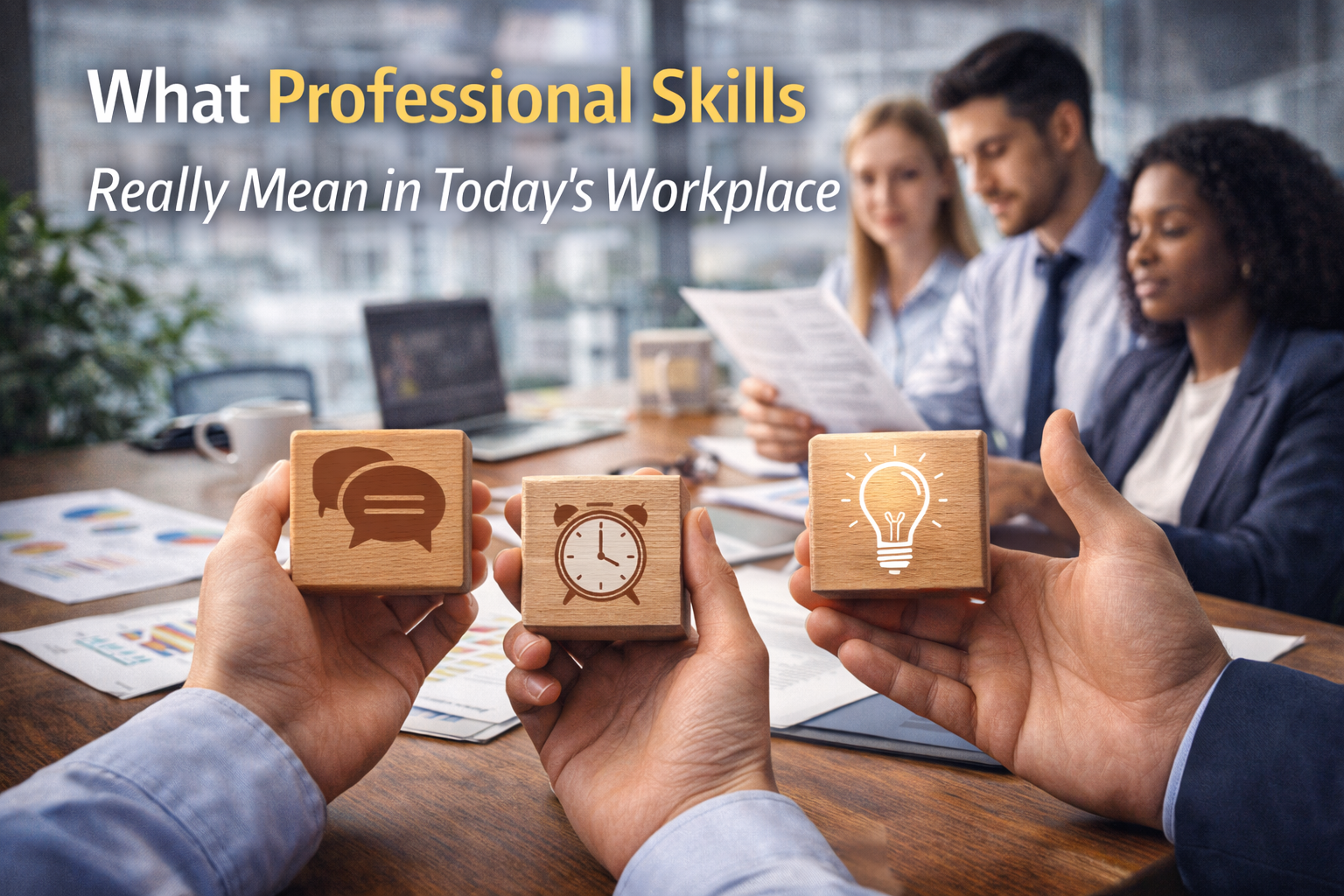
The concept of professional skills has evolved significantly in the modern workplace. While technical expertise remains essential, a growing body of research shows that transferable skills often referred to as soft skills are critical predictors of long-term career success, leadership effectiveness, and organizational performance.
Professional skills influence how individuals communicate, collaborate, adapt to change, manage responsibilities, and contribute to workplace culture. Unlike technical competencies that may become obsolete as technologies evolve, professional skills remain relevant across industries and career stages.
This article explores what professional skills truly mean today, supported by data, academic research, and institutional reports.
Defining Professional Skills from a Research Perspective
Professional skills refer to interpersonal, cognitive, and self-management abilities that enable individuals to function effectively in professional environments.
According to the World Economic Forum in its Future of Jobs Report 2023, the most in-demand skills globally include:
- Analytical thinking
- Creative thinking
- Resilience and flexibility
- Motivation and self-awareness
- Curiosity and lifelong learning
Source: https://www.weforum.org/reports/the-future-of-jobs-report-2023/
These skills are not tied to a single occupation. Instead, they enable adaptability across roles and industries, particularly in rapidly changing economic environments.
Research consistently shows that employers prioritize these competencies because they enhance collaboration, innovation, and sustainable performance.
The Shift in Employer Expectations
Workplace expectations have shifted significantly over the past two decades. Automation and digital transformation have increased demand for human-centered skills.
The McKinsey & Company reports that social and emotional skills are becoming increasingly important as routine tasks are automated.
Source: https://www.mckinsey.com/featured-insights/future-of-work
Their research indicates that demand for advanced cognitive and social skills is rising across industries, particularly in roles requiring collaboration, leadership, and complex problem-solving.
This shift highlights that professional skills are no longer optional they are essential for employability.
Communication as a Core Professional Skill
Communication consistently ranks among the most valued professional skills.
According to the National Association of Colleges and Employers (NACE) Job Outlook Survey, communication skills are among the top attributes employers seek in candidates.
Source: https://www.naceweb.org/job-market/trends-and-predictions/job-outlook/
Effective communication includes:
- Clear verbal expression
- Professional writing
- Active listening
- Constructive feedback
- Audience awareness
Research in organizational behavior shows that teams with strong communication practices experience fewer conflicts and higher productivity.
In remote and hybrid work environments, communication clarity becomes even more critical to avoid misunderstandings and inefficiencies.
Collaboration and Team Effectiveness
Modern organizations rely heavily on teamwork. A study conducted by Google under Project Aristotle found that psychological safety the belief that team members can speak up without fear was the strongest predictor of team performance.
Source: https://rework.withgoogle.com/print/guides/5721312655835136/
Professional skills such as respect, empathy, accountability, and openness to feedback contribute directly to psychological safety.
Collaborative professionals are better equipped to navigate disagreements, integrate diverse perspectives, and drive innovation.
Adaptability and Resilience
Adaptability has become one of the most important professional skills in the digital economy.
The Organisation for Economic Co-operation and Development (OECD) emphasizes adaptability and lifelong learning as critical competencies for navigating labor market transitions.
Source: https://www.oecd.org/employment/skills-for-jobs/
Professionals who adapt effectively to technological shifts, restructuring, and market volatility tend to experience stronger career stability.
Adaptability includes:
- Openness to feedback
- Willingness to learn
- Flexibility in problem-solving
- Emotional resilience during change
These traits reduce workplace stress and support performance during transitions.
Emotional Intelligence and Workplace Outcomes
Emotional intelligence (EI) plays a measurable role in professional effectiveness.
Research published in Harvard Business Review highlights that emotional intelligence strongly correlates with leadership effectiveness and workplace performance.
Source: https://hbr.org/2004/01/what-makes-a-leader
Emotional intelligence includes:
- Self-awareness
- Self-regulation
- Empathy
- Social skills
- Motivation
Studies in psychology show that professionals with higher EI demonstrate better conflict resolution, stronger relationships, and improved collaboration.
These outcomes contribute directly to team stability and organizational culture.
Time Management and Productivity
Time management and personal accountability are foundational professional skills.
Research from the American Psychological Association links effective self-regulation and goal-setting to improved performance and reduced stress.
Source: https://www.apa.org/monitor/2015/09/self-control
Professionals who manage their priorities effectively tend to:
- Meet deadlines consistently
- Reduce cognitive overload
- Improve task completion rates
- Maintain higher job satisfaction
Responsibility builds trust within teams and strengthens professional reputations.
Ethics, Integrity, and Organizational Trust
Professional ethics are central to sustainable career growth.
According to research from the Ethics & Compliance Initiative, organizations with strong ethical cultures experience lower misconduct rates and higher employee engagement.
Source: https://www.ethics.org/global-business-ethics-survey/
Professional integrity includes honesty, accountability, and respect for policies and colleagues.
Ethical behavior contributes to psychological safety, long-term credibility, and healthier workplace cultures.
Critical Thinking and Problem-Solving
Critical thinking is increasingly valued in complex work environments.
The World Economic Forum consistently ranks analytical thinking among the top global skills for future employment.
Professionals who think critically can:
- Evaluate information objectively
- Identify risks and opportunities
- Make informed decisions
- Propose effective solutions
Cognitive psychology research shows that structured reasoning improves decision accuracy and organizational efficiency.
Problem-solving skills directly influence innovation and competitive advantage.
Self-Management and Long-Term Career Success
Self-management refers to the ability to regulate emotions, maintain discipline, and sustain performance without constant supervision.
Behavioral research demonstrates that self-discipline predicts academic and professional achievement more strongly than short-term motivation alone.
Professionals who practice consistent self-management tend to:
- Adapt more easily to independent work
- Maintain focus during distractions
- Demonstrate reliability
These attributes are especially critical in remote and hybrid work settings.
Continuous Learning and Career Mobility
Continuous learning is now considered a professional competency rather than a supplementary activity.
The LinkedIn Workplace Learning Report consistently shows that professionals who prioritize skill development experience greater internal mobility and career advancement.
Source: https://learning.linkedin.com/resources/workplace-learning-report
A learning-oriented mindset enables individuals to remain competitive as industries evolve.
Lifelong learning supports adaptability, innovation, and resilience.
Professional Skills and Career Advancement
Research indicates that career progression depends heavily on professional skills.
A study by Stanford University on leadership development highlights that interpersonal competence significantly influences advancement into management roles.
Professional skills enable:
- Leadership readiness
- Cross-functional collaboration
- Strategic thinking
- Effective stakeholder communication
Technical expertise may open doors, but professional skills often determine who advances.
The Strategic Value of Professional Skills
Professional skills contribute to:
- Workplace engagement
- Team performance
- Organizational culture
- Innovation capacity
- Leadership effectiveness
Data from global institutions consistently confirm that these competencies are measurable drivers of performance.
As automation expands and workplaces become more dynamic, uniquely human capabilities communication, empathy, adaptability, ethical judgment, and critical thinking grow in value.
What Professional Skills Really Mean Today
Professional skills today represent the ability to function effectively in complex, collaborative, and rapidly changing environments.
They are not secondary to technical knowledge. Instead, they amplify technical expertise by enabling professionals to apply their knowledge productively within teams and organizations.
Supported by research from international institutions, management consultancies, and academic studies, the evidence is clear: professional skills are foundational to long-term career resilience and organizational success.
Developing these skills is not merely a personal improvement strategy it is a strategic investment in sustainable professional growth.