
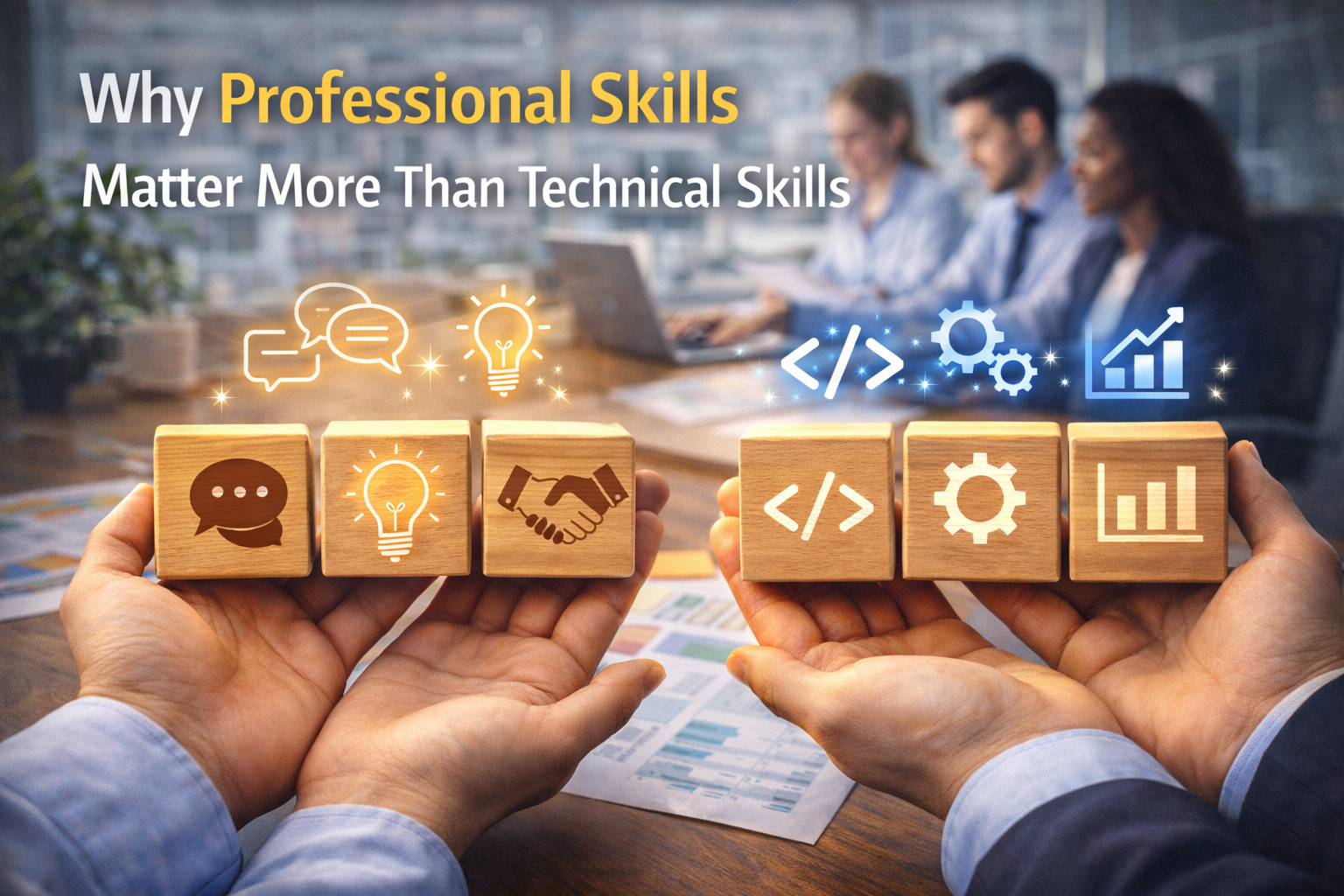
In today’s rapidly evolving workplace, the definition of career success has shifted significantly. While technical expertise remains valuable, research consistently shows that professional skills often called soft skills or human skills play a larger role in long-term career performance and advancement.
Employers increasingly look beyond academic qualifications or technical certifications. They focus on how individuals communicate, collaborate, adapt, and solve problems in complex environments. In fact, multiple workforce studies indicate that professional skills are often the key differentiator between average and exceptional employees.
Understanding the growing importance of professional skills can help individuals build resilient careers in a labor market shaped by automation, globalization, and continuous technological change.
Understanding the Difference Between Professional and Technical Skills
Before examining why professional skills matter more, it is important to distinguish between the two categories.
Technical Skills
Technical skills refer to specific knowledge and abilities required to perform particular tasks or operate specialized tools.
Examples include:
- Programming languages
- Data analysis
- Accounting techniques
- Graphic design software
- Engineering processes
These skills are typically learned through formal education, certifications, or training programs.
Professional Skills
Professional skills are transferable abilities that influence how people interact, solve problems, and manage work responsibilities.
Common professional skills include:
- Communication
- Critical thinking
- Time management
- Adaptability
- Emotional intelligence
- Collaboration
- Leadership
Unlike technical skills, professional skills apply across industries and job roles.
According to the National Association of Colleges and Employers (NACE), employers consistently rank communication, teamwork, and problem-solving among the most important hiring criteria.
Source:
https://www.naceweb.org/career-readiness/competencies/career-readiness-defined/
The Changing Nature of Work
One of the main reasons professional skills have become more valuable is the rapid transformation of the labor market.
Technological advancements are continuously reshaping industries, which means many technical skills become outdated relatively quickly.
The World Economic Forum’s Future of Jobs Report highlights that technological change will significantly alter workplace skill requirements.
According to the report:
- 44% of workers’ core skills are expected to change within five years.
Source:
https://www.weforum.org/reports/the-future-of-jobs-report-2023/
This constant change means employees must regularly learn new tools and technologies. Professional skills such as adaptability and learning ability make this transition possible.
Why Employers Value Professional Skills
Organizations increasingly prioritize professional skills because they influence workplace effectiveness, culture, and long-term productivity.
A study conducted by LinkedIn Global Talent Trends found that 92% of hiring professionals say soft skills are just as important or more important than technical skills.
Source:
https://www.linkedin.com/business/talent/blog/talent-strategy/linkedin-global-talent-trends
Employers often assume that technical skills can be taught through training programs. However, professional skills are more difficult to develop quickly and therefore become a key factor in hiring decisions.
Professional Skills and Workplace Performance
Research shows that professional skills strongly influence workplace productivity and effectiveness.
According to a study from Harvard University, the Carnegie Foundation, and the Stanford Research Center, approximately:
- 85% of career success comes from well-developed soft skills
- 15% comes from technical skills
Source:
https://www.cnbc.com/2017/12/27/harvard-study-85-percent-of-job-success-comes-from-soft-skills.html
While technical knowledge allows individuals to complete tasks, professional skills determine how efficiently and effectively they perform those tasks within teams and organizations.
Communication as a Career Accelerator
Communication is one of the most frequently cited professional skills in workplace research.
Effective communication improves:
- collaboration
- project coordination
- conflict resolution
- leadership effectiveness
According to a report from the National Association of Colleges and Employers, communication skills are consistently ranked among the top attributes employers seek in job candidates.
Professionals who communicate clearly can explain ideas, influence decisions, and build stronger professional relationships.
Adaptability and Long-Term Employability
Adaptability is another critical professional skill, particularly in a rapidly changing job market.
Workers who can adjust to new systems, processes, and expectations tend to remain valuable even when industries evolve.
The World Economic Forum lists adaptability, resilience, and flexibility among the most essential future workforce skills.
Source:
https://www.weforum.org/agenda/2023/05/top-skills-workers-need/
Adaptable professionals are better prepared to transition between roles, industries, or technologies throughout their careers.
Emotional Intelligence and Professional Success
Emotional intelligence refers to the ability to understand, manage, and respond to emotions effectively.
Psychologist Daniel Goleman, who popularized the concept, found that emotional intelligence strongly influences leadership and workplace effectiveness.
Research published in the Harvard Business Review indicates that emotional intelligence is a key factor in leadership performance.
Source:
https://hbr.org/2015/04/emotional-intelligence
Professionals with strong emotional intelligence tend to:
- build stronger relationships
- manage stress effectively
- resolve conflicts constructively
- inspire and motivate others
These abilities contribute directly to long-term career success.
Problem-Solving Beyond Technical Knowledge
Technical expertise helps individuals perform specialized tasks, but complex workplace challenges often require broader thinking.
Effective problem-solving involves:
- critical thinking
- creativity
- collaboration
- decision-making
According to research from the Organisation for Economic Co-operation and Development (OECD), complex problem-solving is a crucial skill for modern work environments.
Source:
https://www.oecd.org/skills/piaac/
Professionals who combine technical knowledge with strong analytical thinking are better equipped to address organizational challenges.
Professional Skills Support Collaboration
Modern organizations rely heavily on teamwork and cross-functional collaboration.
Research on team performance shows that diverse teams often produce better outcomes but only when communication and cooperation are strong.
The Harvard Business Review reports that effective collaboration improves innovation and productivity.
Source:
https://hbr.org/2016/01/collaborative-overload
Professional skills such as accountability, empathy, and communication enable individuals to work effectively within teams.
Why Technical Skills Alone Are Not Enough
Technical expertise remains valuable, but it rarely guarantees long-term success.
Technology evolves quickly, which means specific technical tools may become obsolete.
Professionals who rely solely on technical abilities may struggle when systems change or new tools replace older ones.
Professional skills, however, remain relevant regardless of technological shifts.
They enable individuals to:
- learn new tools quickly
- collaborate across teams
- adapt to new roles
- lead organizational change
Professional Skills and Leadership Development
Leadership research consistently emphasizes professional skills over technical expertise.
While technical knowledge can build credibility, leadership requires abilities such as:
- communication
- empathy
- strategic thinking
- decision-making
According to research from the Center for Creative Leadership, leadership effectiveness depends heavily on interpersonal and communication skills.
Source:
https://www.ccl.org/articles/leading-effectively-articles/what-makes-a-leader/
These skills allow leaders to motivate teams, resolve conflicts, and guide organizations through complex challenges.
The Role of Professional Skills in Career Advancement
Career advancement often depends on trust, collaboration, and reliability.
Employees who demonstrate strong professional behavior are more likely to receive promotions and leadership opportunities.
According to a survey by LinkedIn Learning, communication, leadership, and adaptability remain among the most in-demand skills globally.
Source:
https://learning.linkedin.com/resources/workplace-learning-report
Professionals who cultivate these skills increase their chances of long-term career growth.
Professional Skills in Remote and Hybrid Work
Remote and hybrid work environments have further increased the importance of professional skills.
Without direct supervision, employees must rely more heavily on:
- self-management
- clear communication
- accountability
- organization
Research from McKinsey & Company indicates that remote work success depends heavily on communication and collaboration skills.
Source:
https://www.mckinsey.com/capabilities/people-and-organizational-performance/our-insights
Technical expertise alone is not enough to ensure productivity in distributed teams.
Developing Professional Skills Over Time
Professional skills can be developed through continuous practice and learning.
Strategies for improvement include:
- seeking constructive feedback
- practicing communication and presentation skills
- participating in collaborative projects
- reflecting on workplace experiences
- learning from mentors or coaches
Research in adult learning suggests that deliberate practice and feedback are essential for skill development.
Source:
https://www.apa.org/education-career/guide/teaching-learning
Why Professional Skills Matter More Than Ever
In modern workplaces, success depends not only on knowledge but on how individuals apply that knowledge.
Professional skills shape how people:
- communicate ideas
- navigate challenges
- collaborate with teams
- adapt to change
Research consistently shows that these skills are stronger predictors of long-term success than technical expertise alone.
By developing professional skills alongside technical knowledge, individuals create a powerful foundation for career resilience, leadership potential, and sustainable professional growth.