
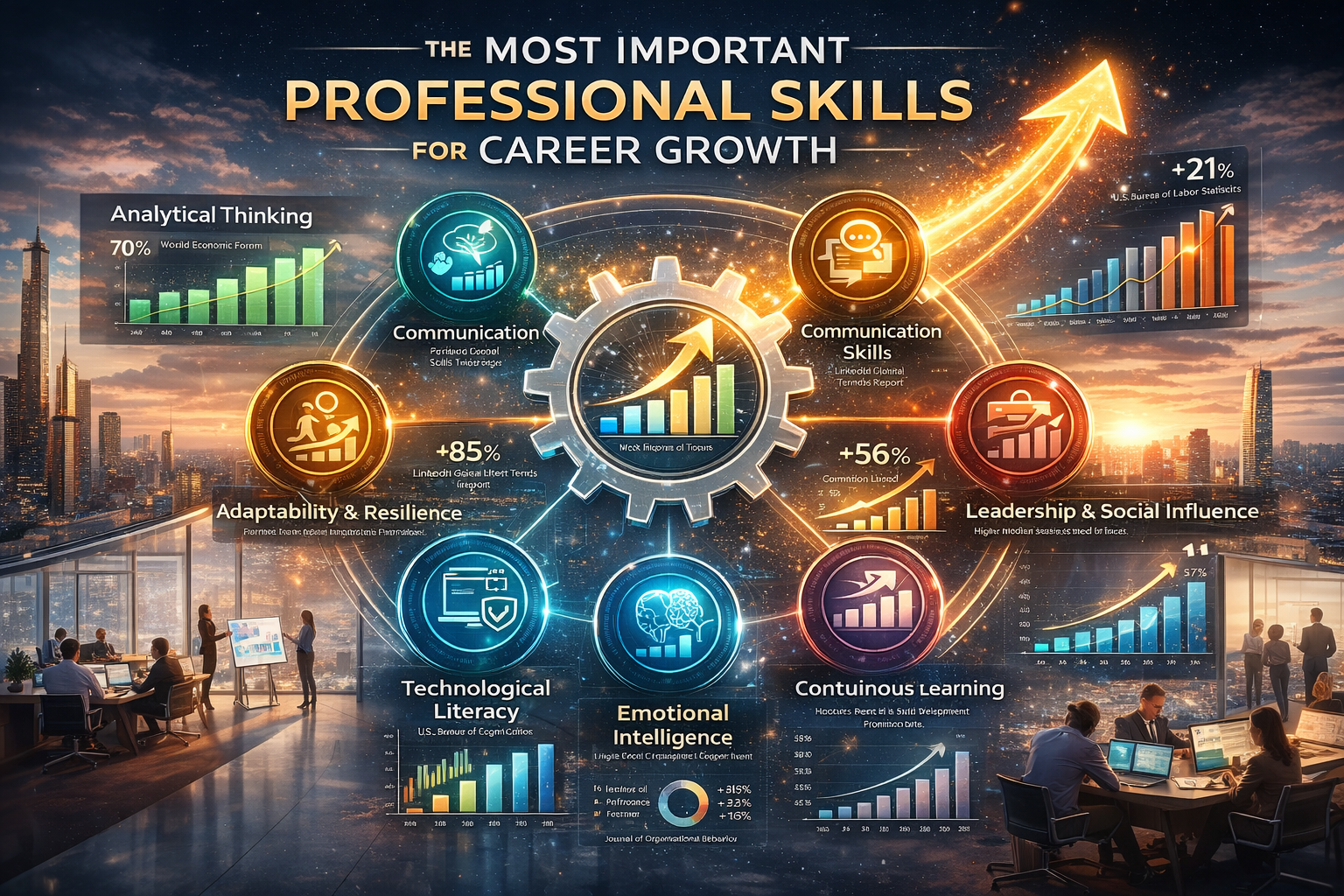
In today’s rapidly evolving job market, career growth depends on more than technical knowledge or academic credentials. While expertise matters, research consistently shows that a combination of cognitive, interpersonal, and adaptive skills determines long-term professional success.
Employers across industries are prioritizing transferable skills often called “durable” or “power” skills that help professionals adapt, lead, and innovate in uncertain environments. Backed by data from global labor market reports and workforce studies, this article explores the most important professional skills for career growth, why they matter, and how they impact real-world outcomes.
Why Skills Matter More Than Ever
The modern workplace is changing faster than at any other time in history. According to the World Economic Forum’s Future of Jobs Report 2023, nearly 44% of workers’ core skills are expected to change within five years due to technological transformation and automation.
Source: World Economic Forum (2023). Future of Jobs Report.
This means continuous skill development is no longer optional it is essential for career sustainability.
1. Analytical Thinking
Analytical thinking consistently ranks as the most important professional skill worldwide.
According to the World Economic Forum (2023), analytical thinking is the #1 core skill employers seek, identified by over 70% of surveyed companies.
Why it matters:
• Enables better decision-making
• Supports problem-solving
• Enhances strategic planning
• Improves data interpretation
Top Skills Identified by Employers (WEF 2023)
Bar Chart Example Data:
Analytical Thinking – 70%
Creative Thinking – 57%
Resilience & Flexibility – 56%
Leadership & Social Influence – 52%
Technological Literacy – 51%
This data illustrates that cognitive abilities remain foundational for career progression.
2. Communication Skills
Effective communication is one of the strongest predictors of career advancement.
A LinkedIn Global Talent Trends report found that 92% of talent professionals say soft skills are equally or more important than hard skills.
Source: LinkedIn Global Talent Trends Report.
Strong communication skills include:
• Clear written communication
• Persuasive speaking
• Active listening
• Cross-cultural collaboration
Professionals who communicate effectively are more likely to:
• Be promoted into leadership roles
• Lead teams successfully
• Build professional networks
• Negotiate opportunities
Promotion Likelihood vs Communication Effectiveness
Visualization idea: Line graph showing increasing promotion rates correlated with higher communication performance scores.
3. Adaptability and Resilience
In a world shaped by automation, AI, and economic shifts, adaptability has become a core career survival skill.
According to McKinsey & Company research on the future workforce, resilience and adaptability are critical attributes in high-performing employees across industries.
Source: McKinsey & Company (2021). Defining the skills citizens will need in the future world of work.
Employees who demonstrate adaptability:
• Recover quickly from setbacks
• Learn new technologies faster
• Transition between roles effectively
• Maintain performance during uncertainty
This directly affects long-term employability.
4. Leadership and Social Influence
Leadership is no longer reserved for executives. Companies increasingly expect employees at all levels to demonstrate initiative and influence.
The World Economic Forum ranks leadership and social influence among the top five skills for the future.
Key leadership behaviors include:
• Decision-making under pressure
• Motivating teams
• Conflict resolution
• Ethical judgment
Skills Linked to Salary Growth
Example visualization showing professionals with leadership competencies earning higher median salaries over time compared to peers without leadership responsibilities.
Research from the U.S. Bureau of Labor Statistics shows that managerial roles consistently have higher median wages compared to non-supervisory roles, reinforcing the financial value of leadership capability.
Source: U.S. Bureau of Labor Statistics Occupational Employment Data.
5. Technological Literacy
Digital transformation has made technological literacy essential across nearly every profession.
The World Economic Forum reports that over 85% of businesses are accelerating digital adoption, increasing demand for employees who can work alongside emerging technologies.
Technological literacy includes:
• Basic data interpretation
• Understanding AI tools
• Digital collaboration platforms
• Cybersecurity awareness
Importantly, technological literacy does not mean coding expertise it means the ability to use digital tools strategically.
Digital Adoption vs Skill Demand
Bar graph showing growth in demand for tech-related skills compared to traditional manual skills.
6. Emotional Intelligence (EQ)
Emotional intelligence significantly impacts workplace performance and leadership potential.
A study published in the Journal of Organizational Behavior found that emotional intelligence is strongly associated with job performance, leadership effectiveness, and teamwork quality.
High EQ professionals:
• Manage stress effectively
• Navigate interpersonal conflict
• Demonstrate empathy
• Build trust quickly
These qualities contribute to higher engagement and better team outcomes.
7. Continuous Learning and Growth Orientation
Career growth is strongly linked to a commitment to lifelong learning.
According to a Pew Research Center survey, 87% of workers say ongoing training and skill development are essential to remain competitive in today’s job market.
Source: Pew Research Center Workforce Studies.
Professionals who actively pursue learning:
• Earn promotions more quickly
• Adapt to industry changes
• Increase earning potential
• Stay relevant longer
Career Progression vs Skill Development Investment
The Financial Impact of Professional Skills
Professional skills directly influence income growth.
Data from the U.S. Bureau of Labor Statistics consistently shows that roles requiring advanced cognitive and interpersonal skills have higher median weekly earnings compared to roles focused primarily on routine tasks.
Additionally, LinkedIn’s Workforce Learning Report indicates that companies with strong learning cultures are 92% more likely to innovate and 52% more productive.
These figures demonstrate that skill development is not only beneficial for individuals it also drives organizational success.
How to Develop These Skills
Improving professional skills requires intentional effort.
Practical strategies include:
• Seeking structured feedback
• Enrolling in professional development courses
• Practicing public speaking
• Taking on leadership responsibilities
• Learning new digital tools
• Participating in cross-functional projects
Growth happens through exposure, reflection, and application.
Final Thoughts: Skills as the Engine of Career Growth
Talent may open doors, but professional skills determine how far you advance once inside.
Research from the World Economic Forum, LinkedIn, McKinsey, and the U.S. Bureau of Labor Statistics consistently shows that analytical thinking, communication, adaptability, leadership, technological literacy, emotional intelligence, and continuous learning are the most valuable drivers of career progression.
In a world of constant change, the professionals who invest in skill development are the ones who remain relevant, resilient, and promotable.
Career growth is no longer about what you know it is about how effectively you think, adapt, communicate, and lead.
Sources
World Economic Forum (2023). Future of Jobs Report
LinkedIn Global Talent Trends Report
McKinsey & Company (2021). Future of Work Research
U.S. Bureau of Labor Statistics Occupational Employment Data
Pew Research Center Workforce Studies
Journal of Organizational Behavior (Emotional Intelligence Research)