
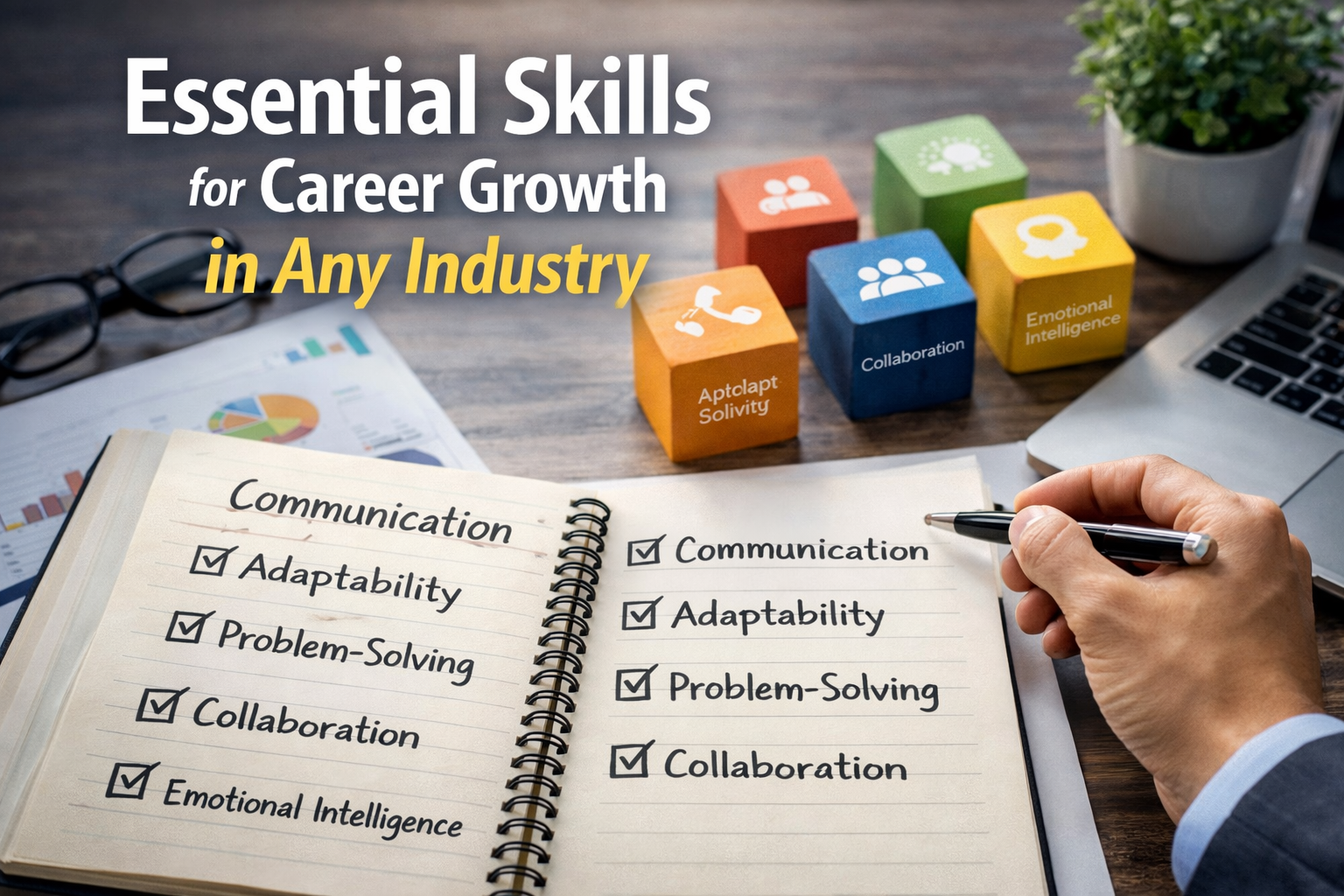
Career growth is no longer defined by a single promotion or a predictable, linear path. In today’s dynamic labor market, professionals must continuously develop essential skills to remain competitive, adaptable, and relevant. Research across economics, psychology, and workforce development consistently shows that long-term career success depends not only on technical expertise but also on transferable skills that apply across industries.
Understanding and strengthening these core competencies can significantly improve employability, performance, and professional resilience.
Why Skills Matter More Than Ever
The global workforce is undergoing rapid transformation. According to the World Economic Forum’s Future of Jobs Report 2023, 44% of workers’ core skills are expected to change within the next five years due to technological advancement, automation, and evolving business models.
Source: World Economic Forum (2023). Future of Jobs Report.
This shift highlights the growing importance of adaptable, transferable skills. While job titles and technologies evolve, foundational competencies such as communication, analytical thinking, and collaboration remain consistently valuable.
Additionally, research from the McKinsey Global Institute indicates that demand for social, emotional, and higher cognitive skills is rising faster than demand for manual or routine skills across most economies.
Source: McKinsey Global Institute (2018). Skill Shift: Automation and the Future of the Workforce.
Professionals who invest in these enduring skills are better positioned to transition between roles and industries over time.
Communication Skills
Communication is consistently ranked among the most important workplace competencies. According to the National Association of Colleges and Employers (NACE) Job Outlook Survey, employers regularly identify communication skills as one of the top attributes sought in candidates.
Source: National Association of Colleges and Employers (NACE), Job Outlook Survey.
Effective communication includes verbal clarity, professional writing, active listening, and the ability to adapt messages to different audiences. Research in organizational behavior shows that teams with strong communication practices experience higher performance and fewer conflicts.
A study published in the Journal of Applied Psychology found that communication quality is strongly correlated with team effectiveness and job satisfaction.
Source: Journal of Applied Psychology, research on communication and team performance.
In any industry, the ability to express ideas clearly and collaborate effectively directly influences career advancement.
Critical Thinking and Problem-Solving
Critical thinking enables professionals to evaluate information, assess risks, and make informed decisions. The World Economic Forum consistently ranks analytical thinking as the most in-demand skill globally.
Source: World Economic Forum (2023). Future of Jobs Report.
Problem-solving is especially important in complex work environments where professionals must navigate uncertainty. Cognitive psychology research indicates that structured problem-solving approaches improve decision accuracy and reduce bias.
Source: Kahneman, D. (2011). Thinking, Fast and Slow.
Professionals who demonstrate strong analytical and problem-solving skills are more likely to be entrusted with leadership responsibilities and strategic tasks.
Adaptability and Flexibility
Adaptability has become a core professional requirement. According to LinkedIn’s Global Talent Trends report, adaptability is among the top soft skills employers value in an unpredictable economic landscape.
Source: LinkedIn Global Talent Trends Report.
Research published in the Journal of Vocational Behavior shows that career adaptability is positively associated with job performance, career satisfaction, and long-term employability.
Source: Journal of Vocational Behavior, research on career adaptability.
Adaptable professionals are more comfortable learning new systems, embracing organizational change, and adjusting to evolving responsibilities. This flexibility significantly enhances career sustainability.
Emotional Intelligence
Emotional intelligence refers to the ability to understand, regulate, and respond to emotions effectively. Research by psychologist Daniel Goleman and subsequent organizational studies show that emotional intelligence strongly predicts leadership effectiveness and workplace performance.
Source: Goleman, D. (1998). Working with Emotional Intelligence.
A meta-analysis published in the Journal of Organizational Behavior found a significant relationship between emotional intelligence and job performance across industries.
Source: Journal of Organizational Behavior, meta-analysis on emotional intelligence and performance.
Professionals with high emotional intelligence tend to manage stress better, resolve conflicts constructively, and build stronger professional relationships.
Time Management and Organizational Skills
Time management directly affects productivity and job performance. Research from the American Psychological Association indicates that structured planning and prioritization improve task completion rates and reduce workplace stress.
Source: American Psychological Association, research on productivity and time management.
Effective time management involves setting priorities, meeting deadlines, and maintaining consistent workflow. These skills are universally relevant, regardless of industry or role.
Professionals who manage time effectively are more likely to maintain performance standards and achieve career milestones.
Continuous Learning and Skill Development
The ability to learn continuously is increasingly essential. According to a Pew Research Center survey, 87% of workers say ongoing training and skill development are important for staying competitive in today’s job market.
Source: Pew Research Center, Workforce Development Survey.
Additionally, LinkedIn’s Workplace Learning Report indicates that organizations with strong learning cultures are more innovative and productive.
Source: LinkedIn Workplace Learning Report.
A continuous learning mindset supports adaptability, enhances competence, and increases long-term career mobility.
Collaboration and Teamwork
Modern workplaces rely heavily on collaboration. Research from Google’s Project Aristotle identified psychological safety and effective collaboration as key drivers of high-performing teams.
Source: Google re:Work, Project Aristotle research.
Collaboration requires communication, accountability, mutual respect, and shared responsibility. Professionals who work effectively within teams contribute to stronger outcomes and organizational success.
These abilities are equally valuable in remote, hybrid, and in-person work environments.
Decision-Making Skills
Decision-making is critical for efficiency and leadership development. Behavioral science research shows that individuals who use structured decision-making frameworks experience greater confidence and reduced cognitive overload.
Source: Journal of Personality and Social Psychology, research on decision processes.
Clear decision-making supports accountability and aligns actions with long-term professional objectives.
Professionals who develop this skill are more likely to take initiative and assume leadership roles.
Professional Ethics and Integrity
Integrity remains one of the most valued professional qualities. Research in business ethics demonstrates that trust and ethical conduct significantly influence reputation, leadership potential, and career longevity.
Source: Harvard Business Review, research on ethical leadership.
Professionals who demonstrate accountability, transparency, and respect build stronger networks and long-term credibility.
Ethical behavior contributes not only to personal career growth but also to organizational stability.
Self-Management and Discipline
Self-management refers to regulating behavior, maintaining focus, and consistently following through on commitments. Studies in behavioral psychology suggest that self-discipline is a stronger predictor of long-term achievement than intelligence alone.
Source: Duckworth, A. (2016). Grit: The Power of Passion and Perseverance.
Professionals who manage their energy, habits, and priorities effectively are more likely to achieve sustained career progress.
Consistency, rather than intensity, drives long-term professional growth.
Building Sustainable Career Growth
Essential skills do not operate independently. Communication enhances collaboration. Adaptability supports learning. Emotional intelligence strengthens leadership. Critical thinking improves decision-making.
Together, these competencies form a durable foundation for career growth across industries.
Labor market research consistently shows that transferable skills increase employability and career mobility. As industries continue to evolve, professionals who invest in adaptable, evidence-based skill development position themselves for long-term relevance.
Career growth is not defined by a single opportunity or promotion. It is shaped by continuous improvement, strategic development, and intentional skill-building over time.
References
World Economic Forum (2023). Future of Jobs Report
McKinsey Global Institute (2018). Skill Shift: Automation and the Future of the Workforce
National Association of Colleges and Employers (NACE). Job Outlook Survey
Journal of Applied Psychology
Kahneman, D. (2011). Thinking, Fast and Slow
LinkedIn Global Talent Trends Report
Journal of Vocational Behavior
Goleman, D. (1998). Working with Emotional Intelligence
Journal of Organizational Behavior
American Psychological Association
Pew Research Center Workforce Survey
LinkedIn Workplace Learning Report
Google re:Work – Project Aristotle
Journal of Personality and Social Psychology
Harvard Business Review – Ethical Leadership Research
Duckworth, A. (2016). Grit: The Power of Passion and Perseverance