
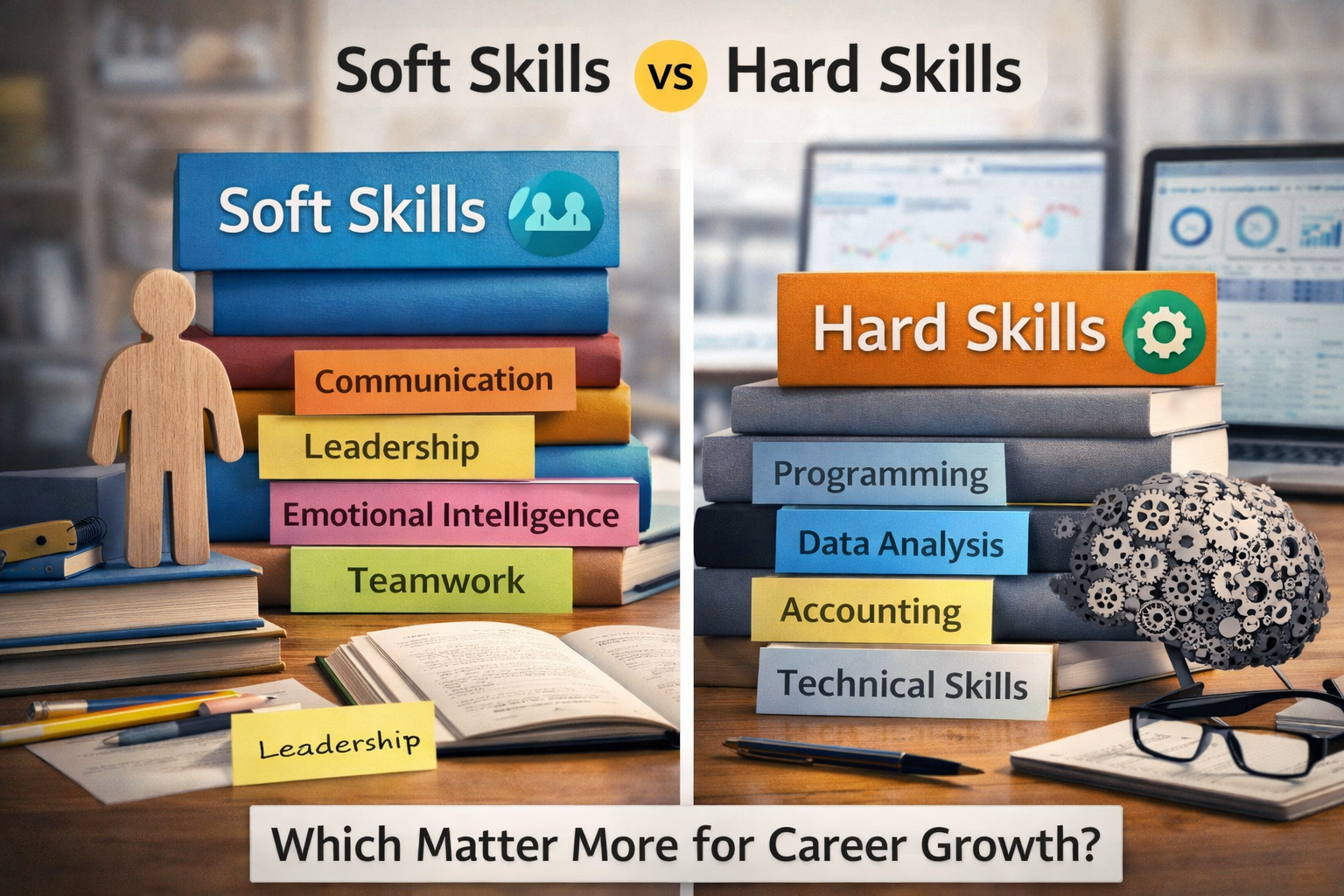
In today’s competitive job market, professionals often ask a crucial question: what truly drives career growth technical expertise or interpersonal abilities?
The debate between soft skills and hard skills has become increasingly relevant as workplaces evolve. While technical knowledge remains essential, research from leading institutions suggests that long-term success depends on a combination of both often with a surprising emphasis on soft skills.
This article explores the differences between these two skill sets, what science says about their impact, and how you can leverage both to accelerate your career.
What Are Hard Skills?
Hard skills are technical, measurable abilities that are typically learned through education, training, or hands-on experience.
Examples include:
- Programming and coding
- Data analysis
- Graphic design
- Accounting and financial modeling
- Language proficiency
These skills are often job-specific and can be tested, certified, or demonstrated through practical tasks.
According to the World Economic Forum, technical skills remain essential in a rapidly changing job market, especially with the rise of automation and artificial intelligence.
🔗 Source: https://www.weforum.org/reports/the-future-of-jobs-report-2023
However, technical expertise alone is no longer enough to guarantee long-term career success.
What Are Soft Skills?
Soft skills are behavioral and interpersonal abilities that influence how you work and interact with others.
Common examples include:
- Communication
- Emotional intelligence
- Adaptability
- Leadership
- Problem-solving
- Teamwork
Unlike hard skills, soft skills are harder to measure but play a crucial role in workplace effectiveness.
Research from the Harvard Division of Continuing Education suggests that up to 85% of job success comes from well-developed soft skills, while only 15% comes from technical skills.
🔗 Source: https://professional.dce.harvard.edu/blog/soft-skills-are-the-key-to-career-success/
This highlights the growing importance of human-centered abilities in modern careers.
The Changing Nature of Work
The workplace has changed dramatically over the past decade.
Automation and AI are increasingly handling repetitive technical tasks, making uniquely human skills more valuable.
A report from the McKinsey Global Institute found that demand for social and emotional skills is expected to grow significantly in the coming years.
🔗 Source: https://www.mckinsey.com/featured-insights/future-of-work
Skills such as communication, collaboration, and critical thinking are becoming essential across industries.
What Do Employers Value More?
Multiple studies indicate that employers prioritize soft skills when hiring and promoting employees.
A LinkedIn Global Talent Trends report found that 92% of talent professionals say soft skills are equally or more important than hard skills.
🔗 Source: https://www.linkedin.com/business/talent/blog/talent-strategy/soft-skills-are-hard
Additionally, the same report highlights that candidates with strong soft skills are more likely to:
- Adapt to new roles
- Collaborate effectively
- Handle workplace challenges
This makes them more valuable in dynamic work environments.
Why Soft Skills Drive Career Growth
While hard skills may help you get a job, soft skills often determine how far you go.
1. Communication Impacts Everything
Effective communication is one of the most critical workplace skills.
According to the National Association of Colleges and Employers (NACE), communication consistently ranks among the top skills employers seek.
🔗 Source: https://www.naceweb.org/career-readiness/competencies/
Poor communication can lead to misunderstandings, delays, and missed opportunities.
2. Emotional Intelligence Boosts Leadership
Emotional intelligence (EQ) is the ability to understand and manage emotions both your own and others’.
Research published in Harvard Business Review shows that emotional intelligence is a key predictor of leadership effectiveness.
🔗 Source: https://hbr.org/2017/02/emotional-intelligence-has-12-elements-which-do-you-need-to-work-on
Leaders with high EQ are better at:
- Managing teams
- Resolving conflicts
- Building trust
3. Adaptability Is Essential in a Fast-Changing World
The ability to adapt is more important than ever.
The World Economic Forum lists adaptability and resilience among the top skills for the future workforce.
🔗 Source: https://www.weforum.org/agenda/2020/10/top-skills-of-2025/
Employees who can quickly adjust to new technologies and environments have a significant advantage.
Why Hard Skills Still Matter
Despite the growing importance of soft skills, hard skills remain fundamental.
Without technical competence, it is difficult to perform core job functions.
For example:
- A software developer must know programming languages
- A financial analyst must understand data modeling
- A designer must master design tools
A study from the OECD (Organisation for Economic Co-operation and Development) shows that strong technical skills are directly linked to employability and income levels.
🔗 Source: https://www.oecd.org/skills/
In short, hard skills open doors but soft skills determine how far you walk through them.
The Ideal Balance: A Hybrid Skill Set
The most successful professionals combine both skill types.
This combination is often referred to as a “T-shaped skill set”:
- Deep expertise in one area (hard skills)
- Broad abilities across multiple areas (soft skills)
According to McKinsey, organizations increasingly seek individuals who can combine technical expertise with strong interpersonal abilities.
🔗 Source: https://www.mckinsey.com/capabilities/people-and-organizational-performance
This balance allows professionals to:
- Solve complex problems
- Communicate solutions effectively
- Collaborate across teams
Real-World Example
Consider two employees:
- Employee A: Highly skilled technically but struggles with communication
- Employee B: Technically competent with strong communication and leadership skills
In most cases, Employee B is more likely to be promoted, because they can lead teams, manage stakeholders, and drive results beyond individual tasks.
This aligns with research showing that leadership and collaboration are key factors in career advancement.
How to Develop Both Skill Types
Improving Hard Skills
- Take online courses (Coursera, edX)
- Earn certifications in your field
- Practice consistently through real projects
Improving Soft Skills
- Seek feedback from colleagues
- Practice active listening
- Work in team environments
- Develop emotional awareness
Building both skill sets requires continuous learning and intentional effort.
The Future of Career Growth
As workplaces continue to evolve, the balance between soft and hard skills will become even more important.
Automation will handle more technical tasks, while human skills will drive innovation, leadership, and collaboration.
A report from the World Economic Forum predicts that analytical thinking, creativity, and emotional intelligence will be among the most valuable skills in the future.
🔗 Source: https://www.weforum.org/reports/the-future-of-jobs-report-2023
So, Which Matters More?
The evidence is clear: both soft skills and hard skills are essential but soft skills often have a greater impact on long-term career growth.
- Hard skills help you get hired
- Soft skills help you grow, lead, and succeed
The most effective strategy is not choosing one over the other, but developing both in a balanced way.
A Smarter Approach to Career Success
Career growth is no longer defined solely by technical expertise. It depends on how well you can combine knowledge with human interaction.
By investing in both soft and hard skills, you position yourself for:
- Better job opportunities
- Faster promotions
- Stronger professional relationships
- Long-term career stability
In a world where change is constant, the professionals who thrive are those who can adapt, communicate, and lead while still delivering technical excellence.