
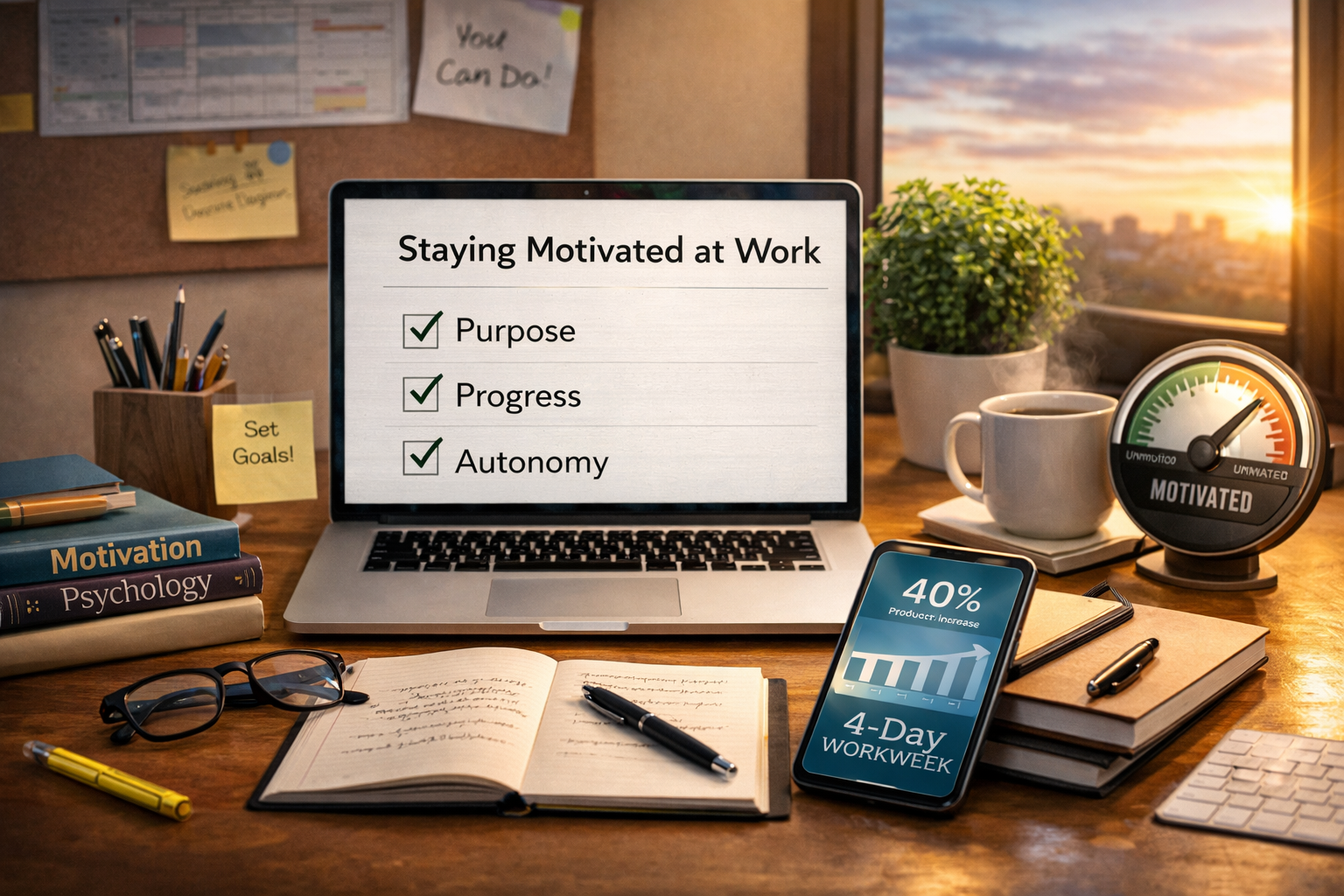
Staying motivated at work is one of the biggest challenges professionals face today. While motivation is often seen as something that comes and goes, research in psychology shows that it is not just a feeling it is a system that can be understood, managed, and strengthened.
Studies from leading institutions such as Stanford University, Harvard Business School, and the American Psychological Association (APA) reveal that motivation is deeply connected to autonomy, purpose, progress, and environment not just discipline or willpower.
If you understand how motivation works psychologically, you can create conditions that naturally keep you engaged and productive without relying on constant bursts of inspiration.
What Is Motivation from a Psychological Perspective?
In psychology, motivation is defined as the process that initiates, guides, and maintains goal-oriented behaviors.
One of the most influential frameworks is the Self-Determination Theory (SDT), developed by psychologists Edward Deci and Richard Ryan. According to this theory, motivation is strongest when three basic psychological needs are met:
- Autonomy (feeling in control of your actions)
- Competence (feeling capable and effective)
- Relatedness (feeling connected to others)
🔗 Source: https://selfdeterminationtheory.org/theory/
When these needs are satisfied, individuals experience intrinsic motivation, which is more sustainable and powerful than external rewards like money or recognition.
Intrinsic vs. Extrinsic Motivation
Understanding the difference between intrinsic and extrinsic motivation is key to maintaining long-term engagement at work.
- Intrinsic motivation comes from within (e.g., enjoyment, curiosity, personal growth)
- Extrinsic motivation comes from external rewards (e.g., salary, bonuses, promotions)
A study published in the Journal of Personality and Social Psychology found that intrinsic motivation leads to higher creativity, persistence, and satisfaction compared to purely extrinsic incentives.
🔗 Source: https://psycnet.apa.org/record/2000-13324-007
This doesn’t mean external rewards are useless but relying solely on them can reduce long-term motivation.
The Role of Purpose in Staying Motivated
Purpose is one of the strongest drivers of motivation.
Research from Harvard Business School professor Teresa Amabile shows that people are more motivated when they see meaning in their work. Her “Progress Principle” study found that even small wins in meaningful tasks can significantly boost motivation and emotional engagement.
🔗 Source: https://hbr.org/2011/05/the-power-of-small-wins
When work feels meaningful, individuals are more likely to:
- Stay focused
- Persist through challenges
- Experience higher job satisfaction
How Progress Fuels Motivation
One of the most overlooked psychological drivers of motivation is progress.
According to research conducted by Teresa Amabile and Steven Kramer, tracking progress even small achievements can create a positive feedback loop that increases motivation.
This happens because progress triggers the brain’s reward system, releasing dopamine, a neurotransmitter associated with pleasure and reinforcement.
🔗 Source: https://hbr.org/2011/05/the-power-of-small-wins
Practical Strategy
- Break large tasks into smaller steps
- Track daily accomplishments
- Celebrate small wins
These simple actions can significantly increase your motivation over time.
The Science of Focus and Motivation
Motivation is closely linked to focus. Without focus, even highly motivated individuals struggle to produce results.
A study from the University of California, Irvine found that it takes an average of 23 minutes to regain focus after an interruption.
🔗 Source: https://ics.uci.edu/~gmark/chi08-mark.pdf
Frequent distractions reduce motivation because they interrupt progress and create mental fatigue.
How to Improve Focus
- Turn off unnecessary notifications
- Work in dedicated time blocks
- Use tools like the Pomodoro Technique
Maintaining focus helps sustain motivation by allowing continuous progress.
The Impact of Autonomy at Work
Autonomy is a critical factor in motivation.
Research published in the Harvard Business Review shows that employees who feel they have control over their work are more engaged, productive, and satisfied.
🔗 Source: https://hbr.org/2013/01/to-raise-productivity-let-more-employees-work-from-home
When people have autonomy, they are more likely to:
- Take initiative
- Be creative
- Stay motivated without supervision
How to Increase Autonomy
- Set your own goals when possible
- Choose how to approach tasks
- Create a flexible work structure
Even small increases in autonomy can have a significant impact.
Energy Management and Motivation
Motivation is not just psychological it is also biological.
A study from Harvard Medical School shows that lack of sleep negatively affects attention, decision-making, and emotional regulation.
🔗 Source: https://health.harvard.edu/staying-healthy/sleep-and-mental-health
Additionally, research from Stanford University indicates that overworking leads to reduced productivity and increased burnout.
🔗 Source: https://web.stanford.edu/~pencavel/papers/WorkingPaper.226.pdf
Key Energy Strategies
- Sleep 7–9 hours per night
- Take short breaks during the day
- Stay hydrated
- Maintain a consistent routine
When your energy is optimized, motivation becomes easier to sustain.
The Role of Habits in Motivation
One of the biggest misconceptions is that motivation comes before action. In reality, research shows that action often comes first.
According to behavioral psychology, habits reduce the need for motivation by automating behaviors.
James Clear, author of Atomic Habits, explains that small consistent actions build momentum, which then reinforces motivation.
🔗 Source: https://jamesclear.com/motivation
Build Motivation Through Habits
- Start with small, easy tasks
- Create consistent routines
- Focus on progress, not perfection
Over time, habits reduce resistance and make motivation more stable.
Social Environment and Motivation
Human beings are social by nature, and the environment plays a crucial role in motivation.
Research from the American Psychological Association highlights that supportive work environments increase engagement and reduce stress.
🔗 Source: https://www.apa.org/monitor/2012/10/positive-workplaces
Being surrounded by motivated individuals can:
- Increase accountability
- Improve mood
- Enhance performance
Improve Your Environment
- Collaborate with motivated colleagues
- Seek constructive feedback
- Avoid toxic work environments when possible
Your surroundings can either boost or drain your motivation.
Real-World Example: The Four-Day Workweek
One of the most interesting real-world applications of motivation psychology is the four-day workweek experiment.
In 2019, Microsoft Japan tested a shorter workweek and reported a 40% increase in productivity.
🔗 Source: https://news.microsoft.com/ja-jp/2019/11/04/191104-work-life-choice-challenge-2019-summer/
Employees were more motivated because:
- They had more rest
- Meetings were reduced
- Work became more focused
Similar studies in Iceland and the UK have shown comparable results.
These findings reinforce a key idea: motivation improves when work conditions support human psychology.
A Smarter Way to Stay Motivated
Motivation is not about forcing yourself to work harder it is about creating the right conditions for your brain to function at its best.
Scientific research consistently shows that long-term motivation depends on:
- Meaningful work (purpose)
- Visible progress
- Autonomy and control
- Strong focus
- Healthy energy levels
- Supportive environments
By applying these principles, you can stay motivated at work without relying on temporary bursts of inspiration.
Instead of chasing motivation, you build a system where motivation naturally thrives leading to better performance, greater satisfaction, and sustainable success.