
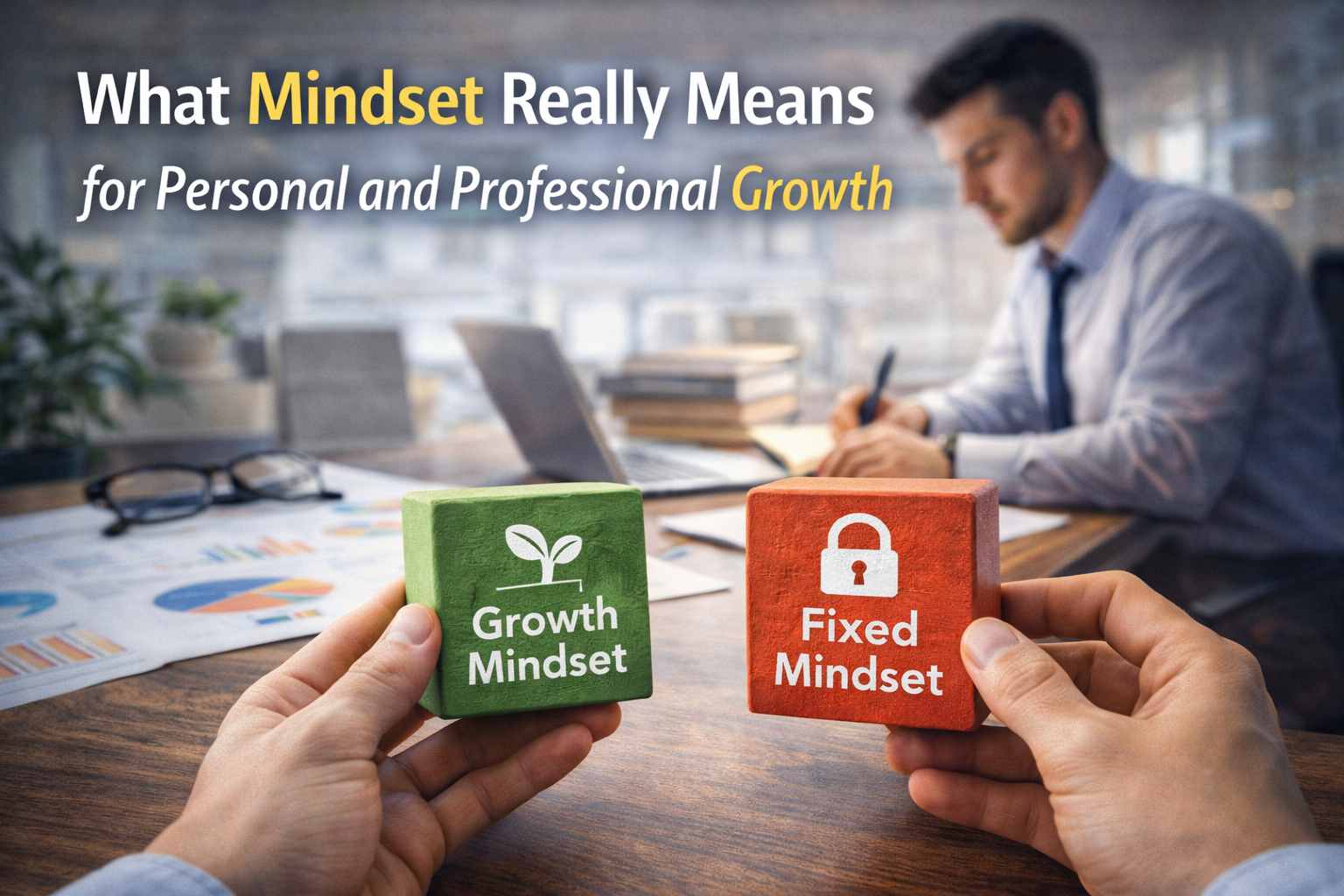
The concept of mindset has become central in discussions about personal development and career success. While often used informally, scientific research in psychology and neuroscience shows that mindset significantly influences how individuals learn, adapt, perform, and respond to challenges. Understanding mindset from an evidence-based perspective allows individuals to approach growth with clarity, resilience, and long-term strategy.
Mindset affects motivation, decision-making, emotional regulation, and performance outcomes in both personal and professional contexts.
Defining Mindset in Psychological Research
In psychology, mindset refers to the core beliefs individuals hold about their abilities, intelligence, and capacity to change. One of the most influential researchers in this field is Carol Dweck of Stanford University.
Dweck’s research identifies two primary frameworks:
A fixed mindset the belief that abilities are largely static
A growth mindset the belief that abilities can be developed through effort, learning, and persistence
In longitudinal studies, students who adopted a growth mindset demonstrated higher academic improvement compared to peers who believed intelligence was fixed (Dweck, 2006). This research has since been replicated across educational and workplace settings.
Mindset is not a personality trait; it is a belief system that can evolve through experience and learning.
Mindset and Learning Behavior
Scientific evidence shows that mindset directly affects learning behavior. A large-scale national study led by David Yeager and colleagues, published in Nature (2019), examined growth mindset interventions across thousands of students in the United States. The findings showed that even brief mindset interventions improved academic performance, particularly among lower-achieving students.
The study demonstrated that students who believed abilities could grow were more likely to:
Seek challenging tasks
Persist after setbacks
Engage more deeply in learning
These behaviors compound over time and significantly influence long-term results.
The Neuroscience Behind Growth
Neuroscience supports the idea that abilities can develop through effort. Research on neuroplasticity the brain’s ability to reorganize itself shows that learning physically changes neural connections.
A landmark study published in Nature (Draganski et al., 2004) found that adults who learned a new skill showed measurable changes in gray matter structure. This evidence confirms that the brain adapts in response to experience and practice.
When individuals understand that the brain can change, they are more likely to persist in the face of difficulty.
Mindset and Motivation
Motivation is closely connected to belief systems. Research in achievement motivation indicates that individuals who believe effort leads to improvement demonstrate higher persistence.
According to studies published in the Journal of Personality and Social Psychology, individuals with a growth mindset are more likely to embrace effort as a pathway to mastery rather than as evidence of weakness.
This internal belief fosters intrinsic motivation, which supports sustained engagement over time.
Mindset and Response to Failure
Failure is an inevitable part of development. The critical difference lies in interpretation.
Research conducted at University of Chicago found that students taught about the malleability of intelligence demonstrated improved resilience and higher grades compared to control groups.
Similarly, organizational research from Harvard Business School shows that companies promoting learning-oriented cultures experience higher innovation and adaptive performance.
When setbacks are interpreted as learning opportunities, individuals adjust strategies rather than withdraw effort.
Workplace Performance and Growth Mindset
In professional settings, mindset influences performance, leadership development, and adaptability.
According to McKinsey & Company, organizations that foster continuous learning cultures are significantly more likely to outperform competitors in innovation and long-term growth.
Employees who believe skills can be developed are more likely to:
Request feedback
Pursue training opportunities
Accept stretch assignments
Adapt to technological change
These behaviors are strongly associated with career mobility and professional advancement.
Mindset and Emotional Resilience
Mindset also influences how individuals interpret stress.
Research by Alia Crum at Stanford University, published in Health Psychology, found that individuals who viewed stress as enhancing rather than debilitating demonstrated improved performance and healthier physiological responses.
This “stress-is-enhancing” mindset affected both emotional resilience and measurable health markers.
The way challenges are framed determines whether they trigger avoidance or constructive action.
Goal Setting and Long-Term Growth
Goal-setting theory, developed by Edwin Locke and Gary Latham, shows that specific and challenging goals improve performance. However, mindset influences whether individuals pursue ambitious goals in the first place.
A growth-oriented mindset encourages process-focused goals, persistence, and adaptive strategies when obstacles arise.
Over time, consistent effort combined with adaptive thinking produces measurable growth in skill, confidence, and performance.
Mindset and Habit Formation
Behavioral science demonstrates that habits are shaped by beliefs about change. Individuals who believe improvement is possible are more consistent in building long-term routines.
Small daily behaviors such as practicing skills, seeking feedback, or reflecting on performance accumulate into substantial progress. Mindset determines whether these habits are sustained during periods of difficulty.
Growth does not occur through isolated effort but through repeated action reinforced by constructive belief systems.
Mindset and Career Development
The modern labor market demands adaptability. According to the World Economic Forum Future of Jobs Report (2023), analytical thinking, resilience, flexibility, and lifelong learning are among the most in-demand skills globally.
These competencies align closely with growth-oriented thinking. Professionals who believe they can learn new skills are more likely to reskill, adapt to automation, and remain competitive.
Mindset therefore influences not only daily behavior but long-term employability.
Can Mindset Be Developed?
Research consistently shows that mindset can change.
Educational and workplace interventions that teach individuals about brain plasticity and learning science have demonstrated measurable behavioral shifts. The large-scale study published in Nature (Yeager et al., 2019) confirms that even short interventions can influence academic performance patterns.
This suggests that mindset is not fixed but responsive to awareness and intentional development.
The Long-Term Impact of Mindset
Over time, mindset shapes patterns of thought, emotional responses, and decision-making. Small daily interpretations how feedback is received, how setbacks are processed, how challenges are approached compound into meaningful differences in outcomes.
Scientific research across psychology, neuroscience, and organizational behavior consistently supports the conclusion that mindset influences learning, resilience, and long-term performance.
Understanding mindset through evidence rather than assumption provides a practical foundation for sustainable growth.
Conclusion
Mindset is more than a motivational concept. It is a scientifically supported framework that influences how individuals learn, respond to difficulty, set goals, and pursue development.
Research from Stanford University, University of Chicago, Harvard Business School, and global institutions such as the World Economic Forum demonstrates that beliefs about growth shape measurable outcomes.
By understanding that abilities can develop through effort and learning, individuals can approach personal and professional challenges with resilience, adaptability, and long-term perspective.
Mindset is not a fixed trait. It is an evolving framework that, when supported by evidence-based practices, becomes a powerful foundation for sustainable personal and professional growth.
References
Crum, A. J., Salovey, P., & Achor, S. (2013). Rethinking stress: The role of mindsets in determining the stress response. Health Psychology.
Draganski, B., et al. (2004). Neuroplasticity: Changes in grey matter induced by training. Nature.
Dweck, C. S. (2006). Mindset: The New Psychology of Success.
Locke, E. A., & Latham, G. P. Goal-setting theory research.
McKinsey & Company. Organizational learning and performance reports.
World Economic Forum (2023). Future of Jobs Report.
Yeager, D. S., et al. (2019). A national experiment reveals where a growth mindset improves achievement. Nature.