
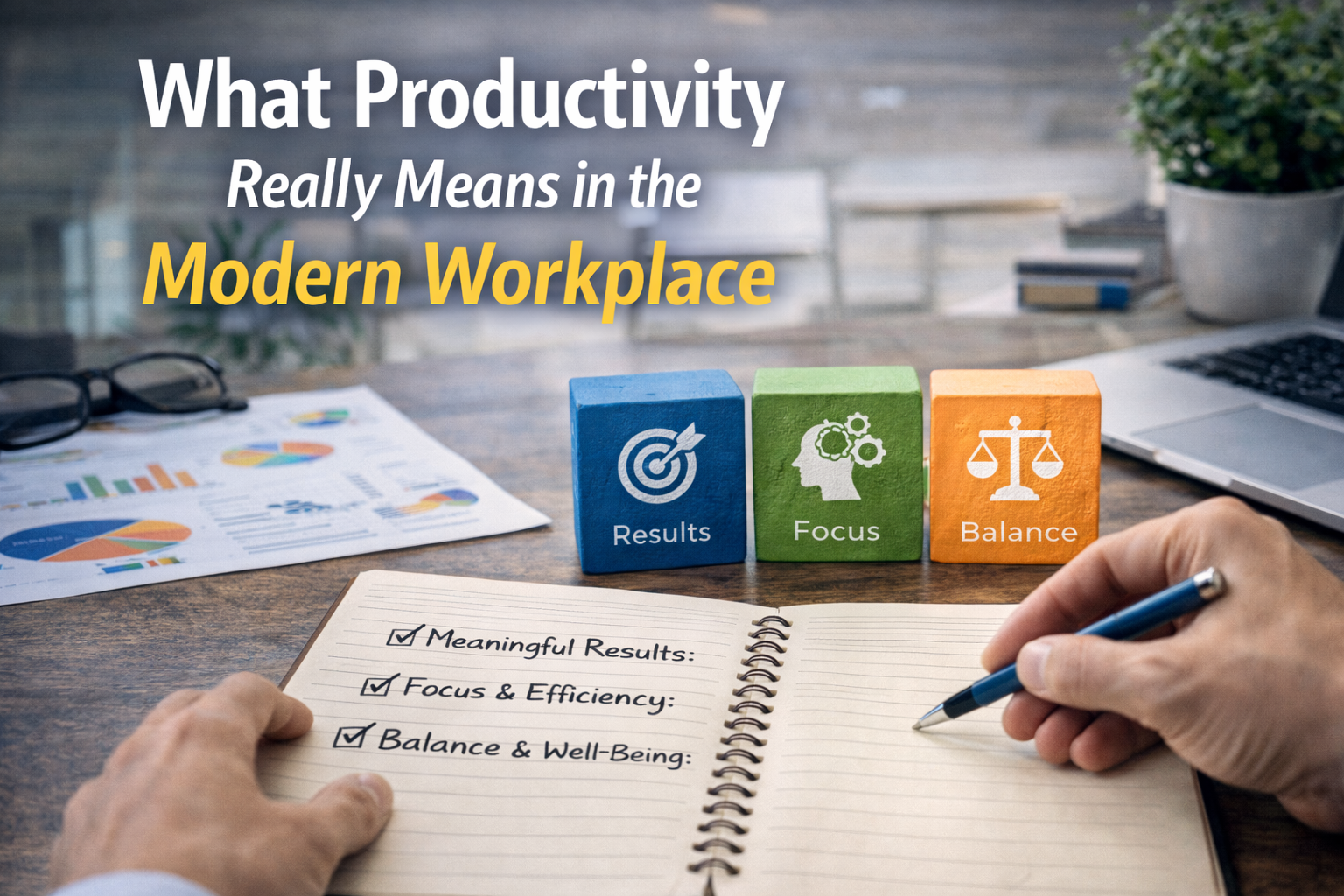
Productivity in the modern workplace is often misunderstood. Many professionals equate productivity with long hours, constant activity, or multitasking. However, research in organizational psychology, neuroscience, and labor economics consistently shows that true productivity is not about doing more tasks. It is about producing meaningful results with focus, efficiency, and sustainability.
Understanding productivity through an evidence-based lens helps individuals and organizations improve performance without compromising well-being.
The Evolution of Productivity at Work
Historically, productivity was measured through output volume and hours worked. During the industrial era, efficiency was associated with repetition and speed. However, as economies shifted toward knowledge-based work, the definition of productivity changed.
According to the Organisation for Economic Co-operation and Development (OECD), productivity in modern economies increasingly depends on innovation, skills, and knowledge rather than labor hours alone. In knowledge-driven sectors, value creation often results from problem-solving, collaboration, and creativity.
This shift requires redefining productivity beyond quantity toward impact and quality.
Working Longer Hours Does Not Guarantee Higher Productivity
One of the most persistent myths about productivity is that longer work hours lead to better performance. Data suggests otherwise.
Research published by Stanford University economist John Pencavel found that productivity declines sharply after 50 hours of work per week, and output drops significantly after 55 hours. Employees working 70 hours produced little more than those working 55 hours due to fatigue and reduced efficiency.
Similarly, the International Labour Organization (ILO) reports that excessive working hours are associated with increased health risks, stress, and lower long-term productivity.
These findings reinforce that sustainable productivity depends on focus and recovery rather than prolonged effort.
The Science of Focus and Deep Work
Neuroscience research shows that attention is a limited cognitive resource. Studies on multitasking indicate that switching between tasks reduces efficiency and increases error rates.
Research from the American Psychological Association highlights that task switching can reduce productivity by up to 40 percent due to cognitive load and mental fatigue.
Focused, uninterrupted work periods improve comprehension, creativity, and output quality. When professionals reduce distractions and concentrate deeply on high-priority tasks, they achieve better results in less time.
Modern productivity therefore emphasizes managing attention, not just managing time.
Quality Over Quantity in Performance
Modern organizations increasingly measure productivity based on outcomes rather than visible activity. According to McKinsey & Company, companies that prioritize outcome-based performance metrics are more likely to report higher employee engagement and stronger financial performance.
Focusing on quality encourages thoughtful planning and prioritization. Instead of rewarding busyness, effective productivity systems reward impact.
Research in organizational behavior supports the idea that meaningful work contributes to both higher performance and increased job satisfaction.
Time Management and Prioritization
Effective time management remains essential, but modern approaches stress prioritization over rigid scheduling. The Eisenhower Matrix and similar prioritization frameworks align with findings from behavioral science showing that decision clarity reduces stress and improves execution.
The Harvard Business Review has published research indicating that professionals who define daily priorities are more likely to achieve long-term goals and report higher satisfaction.
Intentional time allocation ensures that effort is directed toward high-value activities rather than reactive tasks.
Technology’s Double-Edged Impact
Digital tools have improved collaboration and efficiency. However, constant notifications and digital interruptions can hinder productivity.
A study conducted by the University of California, Irvine found that employees take an average of over 20 minutes to regain focus after an interruption.
The modern approach to productivity includes strategic technology use. This means managing notifications, setting boundaries, and using digital tools to streamline rather than fragment workflows.
Productivity and Mental Well-Being
Workplace productivity is closely linked to psychological health. According to World Health Organization (WHO), depression and anxiety cost the global economy an estimated $1 trillion per year in lost productivity.
High stress levels impair cognitive performance, creativity, and decision-making. Sustainable productivity recognizes that rest, recovery, and supportive work environments are essential.
Organizations that promote well-being often experience lower turnover and stronger engagement, reinforcing the connection between mental health and performance.
The Power of Clear Goals
Goal-setting research consistently demonstrates that specific and challenging goals improve performance. Psychologists Edwin Locke and Gary Latham found that clear goals increase motivation and persistence compared to vague intentions.
Clear goals reduce decision fatigue and help professionals allocate time more effectively. When expectations are well defined, productivity improves because effort aligns with measurable outcomes.
Modern productivity systems rely heavily on clarity and alignment.
Collaboration and Collective Productivity
Productivity is not solely an individual metric. Research on team effectiveness shows that collaboration significantly influences output.
A meta-analysis published in the Journal of Applied Psychology found that cohesive teams outperform individuals working in isolation on complex tasks. Clear roles, trust, and communication enhance collective productivity.
In knowledge-based workplaces, collaborative productivity often drives innovation and long-term success.
Productivity in Remote and Hybrid Work
The shift toward remote and hybrid work has reshaped productivity measurement. According to a 2023 report by Microsoft in its Work Trend Index, many employees report stable or improved productivity in hybrid environments when expectations are clear.
Research indicates that autonomy and trust play a significant role in remote productivity. Employees who have flexibility and clearly defined outcomes tend to perform more effectively than those monitored solely by hours worked.
This supports a broader transition toward results-based productivity models.
Habits and Long-Term Performance
Behavioral science research shows that habits reduce cognitive strain and increase consistency. Small, repeatable routines such as planning the day or reviewing priorities compound over time.
Studies on habit formation indicate that structured routines improve self-regulation and reduce procrastination. Consistent systems support sustained productivity without relying on constant motivation.
Productivity, therefore, becomes a function of disciplined habits rather than short bursts of effort.
Measuring Productivity in Meaningful Ways
Traditional metrics based solely on time are increasingly outdated. The OECD and other economic research bodies emphasize measuring productivity through value creation, innovation, and knowledge output.
Meaningful measurement aligns incentives with sustainable performance rather than unhealthy overwork.
Organizations that adopt balanced metrics combining quality, impact, and well-being create more stable and effective work environments.
Redefining Productivity for Long-Term Success
Productivity in the modern workplace means working with clarity, focus, and purpose. It prioritizes meaningful results over constant activity. Research across economics, psychology, and management consistently demonstrates that sustainable productivity depends on attention management, well-being, collaboration, and goal clarity.
By redefining productivity beyond busyness, professionals can achieve stronger performance while maintaining balance. Organizations that adopt evidence-based productivity practices are better positioned for innovation, resilience, and long-term success.
References
International Labour Organization (ILO). Working time and productivity reports.
Locke, E. A., & Latham, G. P. Goal-setting theory research.
McKinsey & Company. Performance and productivity studies (2020–2023).
Microsoft (2023). Work Trend Index.
Organisation for Economic Co-operation and Development (OECD). Productivity and innovation reports.
Pencavel, J. (2014). The productivity of working hours. Stanford University.
University of California, Irvine. Research on workplace interruptions.
World Health Organization (WHO). Mental health and productivity estimates.