
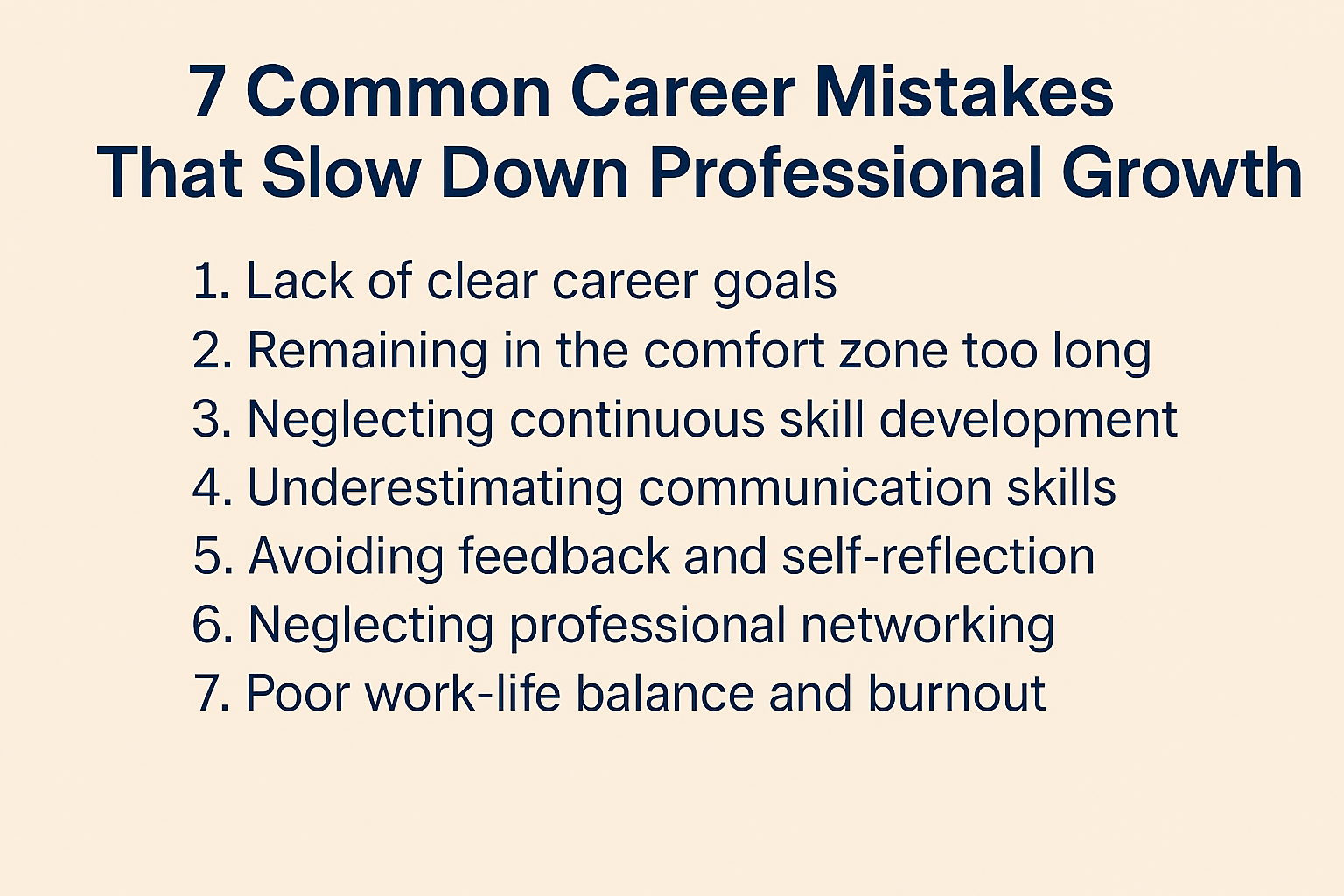
Professional growth is influenced not only by technical ability but also by strategic career decisions, continuous learning, and self-awareness. Research across organizational psychology, human resource management, and labor economics consistently shows that certain behaviors and patterns can significantly delay career advancement. Understanding these career mistakes is essential for professionals aiming for long-term success.
This article outlines seven common career mistakes that slow down professional growth, supported by well-established studies and respected publications.
1. Lack of Clear Career Goals
Why Goal Setting Is Essential
Failing to define clear career goals is one of the most documented barriers to professional development. According to research published in the Journal of Applied Psychology, professionals with clearly articulated short-term and long-term career goals demonstrate higher motivation, stronger professional identity, and greater career satisfaction.
A study by Greco and Kraimer (2019) highlights that goal clarity is strongly associated with career self-management and advancement opportunities (American Psychological Association).
Evidence-Based Recommendation
Career experts recommend reviewing and adjusting career goals regularly, aligning them with skill development and organizational opportunities to maintain momentum.
2. Remaining in the Comfort Zone Too Long
The Risk of Career Stagnation
Staying in the same role without new challenges can result in skill erosion and reduced competitiveness. Harvard Business Review identifies this pattern as one of the most common causes of career stagnation, especially in rapidly changing industries.
Tupper and Ellis (2022) emphasize that professionals who avoid lateral moves, stretch assignments, or uncertainty often experience slower career progression (Harvard Business Review).
Research Insight
Career mobility including lateral growth has been consistently linked to resilience and long-term success across industries.
3. Neglecting Continuous Skill Development
Skills as a Driver of Career Longevity
Multiple systematic reviews show that professionals who stop investing in learning are at higher risk of job insecurity. A 2023 systematic review published in Healthcare (Basel) found that ongoing training significantly reduces turnover intentions and increases employment stability.
The study analyzed over 27 international research papers and confirmed a strong correlation between professional development and career retention (PubMed Central).
Supporting Organizations
Institutions such as Stanford University emphasize lifelong learning as a core requirement for modern professionals (Stanford Lifelong Learning).
4. Underestimating Communication Skills
Communication and Career Advancement
Research in organizational behavior consistently shows that communication skills influence leadership selection, performance evaluations, and promotion decisions.
According to Oxford Academic, effective communication improves collaboration, feedback integration, and leadership credibility, which are critical for upward mobility (Oxford Academic).
Practical Impact
Professionals with strong communication skills are more likely to be considered for leadership roles, regardless of technical background.
5. Avoiding Feedback and Self-Reflection
Why Feedback Matters
Avoiding feedback is a well-documented career-limiting behavior. A large-scale study published in PLoS One shows that professionals who actively seek and apply feedback improve performance significantly faster than those who resist it.
Gnepp et al. (2020) demonstrate that future-focused feedback directly enhances motivation and long-term performance (PLoS One).
Organizational Evidence
The Chartered Institute of Personnel and Development (CIPD) confirms that effective feedback is one of the strongest predictors of sustained performance improvement (CIPD Evidence Review).
6. Neglecting Professional Networking
Networking and Career Success
Decades of longitudinal research confirm the relationship between networking and salary growth, promotions, and job satisfaction. Wolff and Moser’s longitudinal study identified consistent salary growth over time for professionals who actively network (Journal of Applied Psychology PDF).
More recent research from Johns Hopkins University highlights that sustained professional networks amplify social capital and career resilience (PubMed Central).
Key Insight
Professional networking is not optional it is a foundational career management strategy.
7. Poor Work-Life Balance and Burnout
The Hidden Cost of Overwork
Multiple meta-analyses confirm that chronic overwork leads to burnout, reduced productivity, and long-term career dissatisfaction. A 2024 systematic review published in Heliyon found strong links between work-life imbalance, reduced performance, and health-related career disruptions (PubMed Central).
Additional studies show that organizations supporting balance experience higher productivity and lower turnover rates (AIJFR Study).
Sustainable Career Strategy
Career growth is most consistent among professionals who maintain physical health, psychological well-being, and long-term performance capacity.
Final Thoughts
Scientific evidence overwhelmingly shows that career growth is not only about talent, but about intentional behavior, adaptability, and continuous self-investment. By avoiding these seven common career mistakes and applying research-backed strategies professionals can significantly accelerate growth, satisfaction, and long-term success.