
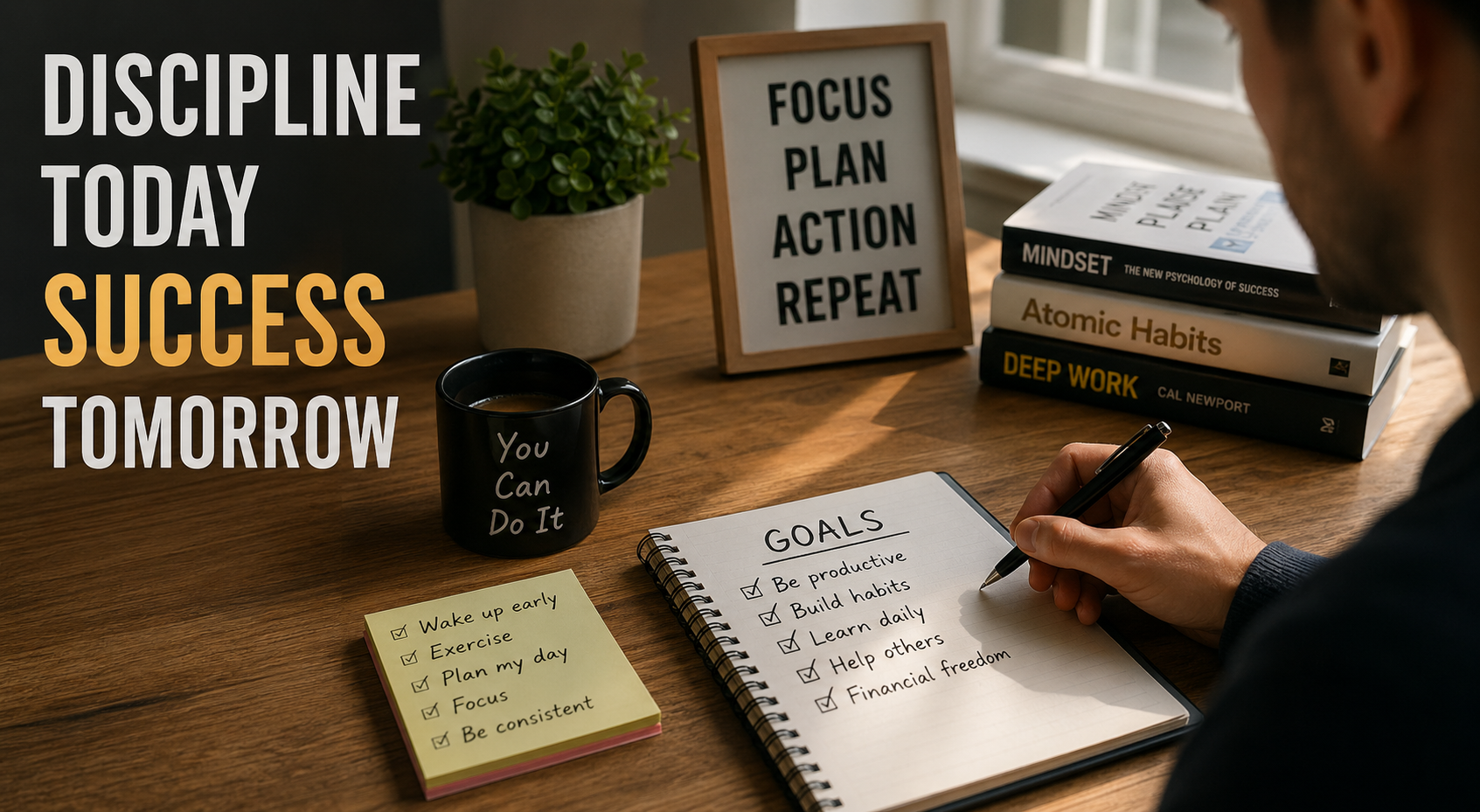
Self-discipline is often described as the bridge between goals and accomplishment. While motivation can fluctuate depending on mood and circumstances, discipline is what sustains progress over time. Research across psychology, neuroscience, and behavioral science consistently shows that self-discipline is a stronger predictor of success than talent or intelligence. Building it is not about willpower alone, but about creating systems, habits, and environments that support consistent action.
Self-discipline can be learned, strengthened, and maintained with the right strategies. This article explores evidence-based methods to help you build lasting discipline and achieve long-term success.
Understanding Self-Discipline and Why It Matters
Self-discipline refers to the ability to control impulses, delay gratification, and stay focused on long-term goals. A well-known study from Stanford University, often referred to as the “Marshmallow Test,” demonstrated that children who were able to delay gratification tended to have better life outcomes, including higher academic performance and better emotional regulation.
Further research reinforces this. A study published in the journal Psychological Science found that self-discipline is a better predictor of academic success than IQ.
Source: https://psycnet.apa.org/record/2004-15743-001
Additionally, a long-term study from the University of Pennsylvania led by psychologist Angela Duckworth highlights that traits like grit and discipline are critical drivers of achievement.
Source: https://www.pnas.org/doi/10.1073/pnas.1016339108
These findings make one thing clear: success is less about natural ability and more about consistent effort over time.
Start With Clear and Meaningful Goals
One of the biggest obstacles to discipline is lack of clarity. When goals are vague, it becomes difficult to stay committed. Research in goal-setting theory shows that specific and challenging goals lead to higher performance compared to vague or easy goals.
A widely cited study by Locke and Latham demonstrates that clear goals significantly improve motivation and persistence.
Source: https://journals.sagepub.com/doi/10.1111/j.1467-6494.2006.00400.x
To apply this:
- Define exactly what you want to achieve
- Break large goals into smaller, actionable steps
- Set deadlines to create urgency
For example, instead of saying “I want to be healthier,” a more effective goal would be “I will exercise for 30 minutes, five times per week.”
Build Habits Instead of Relying on Motivation
Motivation is unreliable. It comes and goes. Habits, on the other hand, automate behavior and reduce the need for constant decision-making.
Research from University College London found that it takes, on average, 66 days to form a new habit, although this can vary depending on complexity.
Source: https://onlinelibrary.wiley.com/doi/10.1002/ejsp.674
Habits are formed through a loop:
- Cue (trigger)
- Routine (behavior)
- Reward
To build discipline effectively:
- Start small to avoid overwhelm
- Attach new habits to existing routines
- Focus on consistency rather than intensity
For example, if your goal is to read daily, start with just 10 minutes a day after breakfast.
Design Your Environment for Success
Self-discipline is not just internal; it is heavily influenced by your environment. Studies in behavioral science show that reducing friction for good habits and increasing friction for bad habits significantly improves adherence.
A study published in Health Psychology found that people are more likely to follow through on intentions when environmental cues support their goals.
Source: https://psycnet.apa.org/record/2012-12916-001
Practical ways to design your environment:
- Remove distractions (e.g., silence notifications)
- Keep tools for good habits easily accessible
- Make undesirable behaviors less convenient
For example, if you want to eat healthier, keep nutritious food visible and accessible while storing unhealthy snacks out of reach.
Practice Delayed Gratification
The ability to delay gratification is a cornerstone of self-discipline. Neuroscience research shows that this ability is linked to the prefrontal cortex, the part of the brain responsible for decision-making and impulse control.
A study published in Nature Communications highlights how individuals with stronger self-control show greater activity in brain regions associated with long-term planning.
Source: https://www.nature.com/articles/ncomms1400
To strengthen delayed gratification:
- Remind yourself of long-term benefits
- Use visualization techniques
- Create rewards that align with your goals
For instance, instead of immediately watching TV after work, complete your planned tasks first and use relaxation as a reward.
Use Implementation Intentions
Implementation intentions are specific “if-then” plans that help automate decision-making. Research by psychologist Peter Gollwitzer shows that these plans significantly increase the likelihood of goal completion.
Source: https://psycnet.apa.org/record/1999-01481-001
Examples:
- “If it is 7 AM, then I will go for a run.”
- “If I feel distracted, then I will take a 5-minute break and return to work.”
This approach reduces the mental effort required to make decisions and helps you stay consistent even when motivation is low.
Track Progress and Measure Results
Tracking progress increases accountability and reinforces positive behavior. Studies show that self-monitoring is one of the most effective behavior change techniques.
A meta-analysis published in American Journal of Preventive Medicine found that individuals who tracked their behavior were significantly more successful in achieving their goals.
Source: https://www.ajpmonline.org/article/S0749-3797(12)00593-9/fulltext
Ways to track progress:
- Use journals or habit-tracking apps
- Record daily or weekly performance
- Reflect on what is working and what is not
Seeing progress, even in small increments, builds momentum and strengthens discipline.
Develop Mental Resilience
Self-discipline is closely tied to resilience the ability to persist despite setbacks. Research from the American Psychological Association emphasizes that resilience can be developed through practice and mindset shifts.
Source: https://www.apa.org/topics/resilience
To build resilience:
- Reframe failures as learning opportunities
- Focus on effort rather than outcome
- Maintain a growth mindset
Psychologist Carol Dweck’s research on growth mindset shows that individuals who believe abilities can be developed are more likely to persist and succeed.
Source: https://www.mindsetworks.com/science/
Manage Energy, Not Just Time
Discipline is not just about time management; it is also about energy management. Studies in occupational health show that productivity depends heavily on physical and mental energy levels.
A study published in Harvard Business Review highlights that managing energy through sleep, nutrition, and breaks leads to higher sustained performance.
Source: https://hbr.org/2007/10/manage-your-energy-not-your-time
To optimize energy:
- Prioritize quality sleep (7–9 hours per night)
- Take regular breaks during work
- Maintain a balanced diet and hydration
When your energy is high, discipline becomes easier to maintain.
Build Consistency Through Identity
One of the most powerful ways to develop discipline is to align your actions with your identity. Instead of focusing only on outcomes, focus on who you want to become.
Research in behavioral psychology suggests that identity-based habits are more sustainable because they reinforce self-image.
For example:
- Instead of saying “I want to write more,” say “I am a writer”
- Instead of “I want to exercise,” say “I am someone who takes care of my health”
Each disciplined action reinforces that identity, making future actions more natural.
Final Thoughts: Turning Discipline Into a Lifestyle
Building self-discipline is not about perfection or rigid control. It is about creating systems that make consistent action easier and more natural over time. Scientific research consistently shows that discipline is a skill that can be developed through clear goals, structured habits, supportive environments, and mental resilience.
Long-term success is rarely the result of one big effort. It is the accumulation of small, disciplined actions repeated daily. By applying the strategies outlined here, you can gradually strengthen your ability to stay focused, overcome distractions, and achieve meaningful goals.
The key is to start small, stay consistent, and trust the process.
Great content! Keep up the good work!