
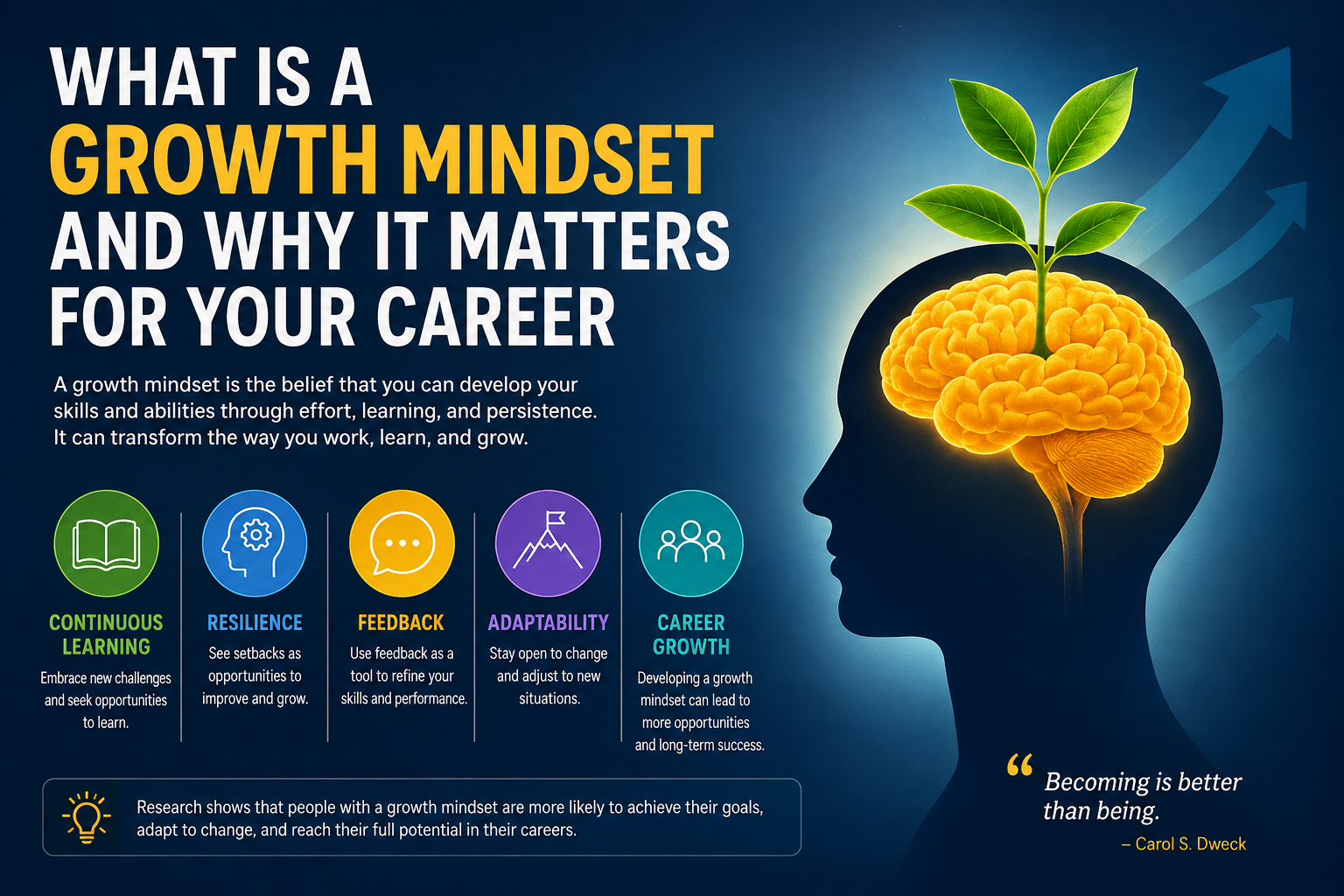
Discover what a growth mindset is, how it differs from a fixed mindset, and what scientific research says about its role in learning, performance, resilience, and career development.
What Is a Growth Mindset
A growth mindset is the belief that skills, abilities, and intellectual capabilities can be developed through learning, effective strategies, practice, feedback, and persistence.
The concept was developed through the research of psychologist Carol S. Dweck and her colleagues. It contrasts with a fixed mindset, in which people tend to view abilities as relatively fixed characteristics.
The difference may sound simple, but it can influence how people respond to challenges, mistakes, criticism, and opportunities to learn.
For example, someone with a more fixed mindset might think:
“I’m just not good at this.”
A growth-oriented response would be:
“I don’t know how to do this yet. What can I learn?”
That small change in perspective can influence what a person does next.
Importantly, a growth mindset does not mean believing that anyone can accomplish anything simply by trying harder. Research suggests that improvement usually requires more than effort alone. Effective strategies, feedback, resources, practice, and supportive environments also matter.
This distinction is particularly important when applying the concept to professional development.
Growth Mindset vs. Fixed Mindset
The easiest way to understand the concept is to compare the two approaches.
| Fixed Mindset | Growth Mindset |
|---|---|
| “I’m not good at this.” | “I can improve with practice and learning.” |
| Avoids difficult challenges | Sees challenges as opportunities to learn |
| Takes mistakes personally | Uses mistakes as information |
| Avoids feedback | Looks for useful feedback |
| Gives up more easily after setbacks | Adjusts strategies and keeps learning |
| Feels threatened by others’ success | Can learn from other people’s experience |
| Focuses heavily on proving ability | Focuses on developing ability |
These are not permanent personality types.
A person can demonstrate a growth mindset in one area of life and a more fixed mindset in another. Someone may be highly confident about learning a new professional skill but become defensive when receiving criticism.
Therefore, growth mindset is better understood as a way of interpreting challenges and abilities rather than a label that permanently defines someone.
Why Does Growth Mindset Matter for Your Career?
Career development rarely follows a perfectly predictable path.
People change jobs, learn new technologies, receive difficult feedback, lose opportunities, take on leadership responsibilities, and sometimes experience professional setbacks.
The ability to learn from these experiences can therefore become an important part of long-term development.
Recent research provides some evidence supporting this connection.
A 2026 meta-analysis published in Personality and Individual Differences examined 80 independent samples from 69 studies involving 26,594 participants. The researchers found positive associations between growth mindset and employee well-being and performance, including task performance and organizational citizenship behavior.
The findings do not mean that having a growth mindset automatically guarantees career success. Instead, they suggest that growth-oriented beliefs can be associated with behaviors and outcomes that are valuable in professional environments.
1. It Encourages Continuous Learning
Modern careers require people to keep learning.
Technology changes. Industries evolve. Companies introduce new processes. Employees move into new positions and are frequently expected to develop skills they did not need earlier in their careers.
A fixed mindset can make this process more uncomfortable.
If someone believes that being “smart” or “talented” means already knowing how to perform, struggling with a new skill may feel like evidence of inadequacy.
A growth mindset changes the interpretation.
Difficulty becomes evidence that there is something new to learn.
This can encourage professionals to:
- Take courses and certifications
- Ask questions
- Seek mentorship
- Learn from experienced colleagues
- Experiment with new approaches
- Request feedback
- Develop skills outside their current responsibilities
Career growth is often less about knowing everything today and more about being capable of learning what tomorrow requires.
2. It Changes How You Respond to Failure
Failure is an unavoidable part of professional life.
You may not get the promotion you wanted. A project may underperform. An interview may not lead to an offer. A presentation may receive criticism. A business idea may fail.
A fixed mindset can turn one disappointing result into a conclusion about personal ability:
“I failed, so I’m not capable.”
A growth mindset encourages a different question:
“What can this experience teach me?”
This does not mean ignoring failure or pretending that every setback is positive.
Instead, it means separating the outcome from your identity.
A failed project can contain information about planning.
A rejected job application can reveal skills that need improvement.
Critical feedback can identify a communication problem.
A missed promotion can highlight competencies that need to be developed.
The objective is not to celebrate failure. The objective is to extract useful information from it.
3. It Makes Feedback More Valuable
Feedback is one of the most important tools for professional development, but receiving it is not always easy.
When someone’s professional identity depends heavily on appearing competent, criticism can feel threatening.
A growth-oriented professional is more likely to treat feedback as information that can improve future performance.
Instead of asking:
“Does this feedback mean I’m not good enough?”
try asking:
“What specific behavior can I improve?”
This distinction matters.
Useful feedback should lead to action.
For example:
Vague response:
“I need to become better at communication.”
Growth-oriented response:
“I need to improve how I structure presentations, communicate key points more clearly, and ask better questions during meetings.”
The second approach turns feedback into a development plan.
4. It Can Help Professionals Adapt to Change
Career success increasingly requires adaptability.
Employees may encounter organizational restructuring, new technologies, changing customer expectations, artificial intelligence, new management systems, or entirely different responsibilities.
A fixed approach can make change feel like a threat to existing competence.
A growth-oriented approach asks:
“What do I need to learn to succeed in this new environment?”
That question moves attention from protecting the past to preparing for the future.
This is particularly relevant in industries where skills become outdated quickly.
A professional who continues learning can potentially remain more adaptable than someone who relies exclusively on skills that worked in the past.
5. It Can Influence Workplace Culture
Growth mindset is not only an individual concept.
Research has also examined what happens when organizations themselves are perceived as having fixed or growth-oriented beliefs about talent.
A study published in Personality and Social Psychology Bulletin examined organizational mindsets across several studies. The researchers found that employees who perceived their organizations as having a more fixed view of talent also reported lower levels of collaboration, innovation, trust, and organizational commitment.
One part of the research included more than 500 employees from seven Fortune 1000 companies.
This suggests that the environment surrounding an employee may matter as much as the employee’s individual mindset.
A company can tell employees to “keep learning,” but if mistakes are punished, questions are discouraged, and people are constantly expected to prove that they are the smartest person in the room, developing a genuine learning culture becomes difficult.
A healthy growth culture should make it possible to learn without constantly fearing failure.
6. Growth Mindset Is Not the Same as “Just Work Harder”
This is one of the most important misconceptions about growth mindset.
Growth mindset does not mean:
“If you try hard enough, you will always succeed.”
Real development is more complicated.
Effort matters, but effort without an effective strategy may not produce meaningful improvement.
Imagine a professional who repeatedly makes the same presentation mistake.
Simply repeating the same behavior for more hours may not solve the problem.
A better approach might involve:
- Identifying the specific weakness.
- Asking for feedback.
- Learning a different technique.
- Practicing deliberately.
- Measuring improvement.
- Adjusting the strategy again.
In other words:
Effort + strategy + feedback + learning = meaningful development.
This is a much more useful interpretation of growth mindset than simply “never give up.”
What Does the Research Actually Say?
The scientific evidence surrounding growth mindset is more nuanced than many popular articles suggest.
A 2018 meta-analysis published in Psychological Science examined 273 studies involving 365,915 participants and found that the overall relationship between growth mindset and academic achievement was weak.
A second meta-analysis examined 43 intervention studies involving 57,155 participants and also found relatively small overall effects.
However, the researchers identified evidence suggesting that certain groups, particularly students facing academic or socioeconomic challenges, may benefit more from mindset interventions.
Later research provided additional evidence under specific circumstances.
In a large national experiment published in Nature in 2019, researchers studied a short online growth-mindset intervention involving students from 76 randomly selected U.S. public high schools, representing more than 12,000 students.
The intervention improved grades among lower-achieving students and increased enrollment in advanced mathematics courses, although the effects depended on the surrounding school environment.
The lesson for professionals is important:
Growth mindset can be useful, but it should not be treated as a magic solution.
Your career is influenced by many factors, including skills, opportunities, economic conditions, education, relationships, organizational culture, health, resources, and sometimes simple luck.
Mindset is one piece of a much larger picture.
How to Develop a Growth Mindset at Work
You do not need to completely change your personality to become more growth-oriented.
Instead, focus on small changes in how you respond to everyday professional situations.
1. Add “Yet” to Your Thinking
Instead of:
“I can’t do this.”
Try:
“I can’t do this yet.”
The word “yet” creates room for development without pretending that the current limitation does not exist.
2. Ask Better Questions After a Setback
Instead of:
“Why am I bad at this?”
Ask:
“What specifically went wrong?”
“What can I control?”
“What should I do differently next time?”
“What skill do I need to develop?”
Questions determine where your attention goes.
Better questions often produce better action.
3. Request Specific Feedback
Instead of asking:
“Did I do a good job?”
Ask:
“What is one thing I could improve in my next presentation?”
Specific questions usually produce more actionable feedback.
4. Focus on Skills, Not Labels
Avoid defining yourself permanently.
Statements such as:
“I’m not a leader.”
“I’m bad at public speaking.”
“I’m not good with technology.”
can become limiting beliefs.
Try converting them into development statements:
“Leadership is a skill I am developing.”
“Public speaking is something I can practice.”
“I need to improve my technology skills.”
This does not guarantee improvement, but it creates a more useful starting point.
5. Study People Who Are Better Than You
Instead of viewing successful colleagues as competition, treat them as sources of information.
Ask yourself:
- What do they do differently?
- How did they develop that skill?
- What habits contribute to their performance?
- What can I adapt to my own situation?
Someone else’s success can become a learning resource.
6. Track Progress Over Time
Career development can be difficult to notice because improvement is often gradual.
Keep a record of:
- Skills learned
- Projects completed
- Feedback received
- Problems solved
- Courses completed
- Responsibilities acquired
- Professional milestones
Looking backward can reveal progress that is difficult to recognize day by day.
A Simple Growth Mindset Framework for Your Career
When you encounter a professional challenge, use this five-step process:
Challenge → Reflection → Feedback → Strategy → Action
Challenge
Identify what is difficult.
Reflection
Understand what happened without turning the result into a judgment about your identity.
Feedback
Seek information from people who can help you improve.
Strategy
Decide what you will change.
Action
Practice the new approach and measure the result.
Then repeat the process.
Growth is rarely a single transformation. It is usually a cycle.
Final Thoughts
A growth mindset is not about believing that you can become anything overnight.
It is about recognizing that many abilities can be developed and that your current level of performance does not necessarily represent your future potential.
For your career, this perspective can encourage continuous learning, constructive responses to feedback, adaptability, and a healthier relationship with professional setbacks.
At the same time, the scientific evidence deserves a balanced interpretation. Growth mindset is not a substitute for education, opportunity, effective strategies, resources, or a supportive workplace.
The most useful question may therefore not be:
“Do I have a growth mindset?”
Instead, ask:
“What am I willing to learn next?”
That question keeps your career focused not only on where you are today, but also on where you can develop from here.
References and Sources
- Dweck, C. S. (2006). Mindset: The New Psychology of Success. Random House.
- Sisk, V. F., Burgoyne, A. P., Sun, J., Butler, J. L., & Macnamara, B. N. (2018). To What Extent and Under Which Circumstances Are Growth Mind-Sets Important to Academic Achievement? Two Meta-Analyses. Psychological Science, 29(4), 549–571.
- Yeager, D. S., et al. (2019). A national experiment reveals where a growth mindset improves achievement. Nature, 573, 364–369.
- Canning, E. A., Murphy, M. C., Emerson, K. T. U., Chatman, J. A., Dweck, C. S., & Kray, L. J. (2020). Cultures of Genius at Work: Organizational Mindsets Predict Cultural Norms, Trust, and Commitment. Personality and Social Psychology Bulletin, 46(4), 626–642.
- Zhao, L., & Liu, B. (2025). The Impact of Growth Mindset on One’s Job Performance and Happiness: Evidence From a Meta-Analysis. Academy of Management Proceedings.
- The relationship between employees’ growth mindset, well-being, and job performance: Evidence from a Meta-analysis. (2026). Personality and Individual Differences, 249, 113507. The meta-analysis included 80 independent samples from 69 studies and 26,594 participants.